Presenting an online reputation plan to your partners in 10 minutes is a challenge that terrifies many executives. Yet it’s doable, and the numbers speak for themselves: according to an IFOP study, 47% of French people have already decided not to buy a product following a scandal, and that figure rises to 59% among 18- to 24-year-olds. In other words, your digital reputation directly impacts your revenue. Convincing your partners in just a few minutes requires a clear approach, compelling arguments, and data-driven evidence. This article provides you with the exact framework to turn an abstract topic into a concrete decision, approved around the table.
In short:
- An effective online reputation presentation consists of three parts: data-driven analysis, competitive risks, and a budgeted action plan.
- Generative AI primarily recommends brands with high brand awareness and positive reviews. Ignoring this shift means ceding market share to the competition.
- A credible communication plan is based on monitoring, gathering authentic feedback, and having a ready-to-use crisis management procedure in place.
- Competitive analysis is the key selling point: showing where you stand compared to your competitors is what wins people over.
- Ten minutes is all it takes if each slide answers a question your partners are actually asking themselves.
Why You Should Convince Your Partners to Invest in Online Reputation Management
The answer can be summed up in one sentence: without a structured online reputation strategy, your competitors will be the ones to win over hesitant customers, and the gap will quickly widen. Your partners need to understand that your online image isn’t a marketing expense, but an asset that secures future revenue.
Start by setting the stage with a striking statistic. When 47% of French people decide not to make a purchase after a bad experience is shared online, every negative review that’s ignored becomes a loss of revenue. Your partners will immediately see what’s at stake: it’s no longer a matter of pride, but of profit margins.
The Influence of Reviews on Purchasing Decisions
Internet users trust reviews from strangers more than they trust advertising. A Nielsen study reveals that 78% of consumers trust recommendations from complete strangers they come across on review platforms. In practical terms, a customer who is torn between two plumbers will check their Google rating before picking up the phone.
Let’s look at a real-world example. A neighborhood real estate agency with a 4.7-star rating based on 100 reviews automatically attracts more listings than a competitor stuck at 3.9. The difference isn’t due to price, but to the trust the agency instills right from the first search. This detail makes all the difference in conversion, as explained in this guide on the reputation of real estate professionals.
Crises often come from within
One point your colleagues tend to underestimate: according to research by Steven Van Belleghem, 84% of reputation crises originate internally—whether from the communications or marketing departments or from employees who lack awareness. The 2016 SFR case—in which employees filmed the destruction of a customer’s phone—remains a textbook example of a preventable blunder.
This observation calls for a structured plan rather than ad-hoc responses. To build a solid case for your partners, draw inspiration from the methods described in this comprehensive guide to corporate online reputation. The key takeaway to keep in mind: your brand image needs to be defended every day, not just when a crisis strikes.
Developing a Clear Three-Part Communication Plan
A compelling online reputation communication plan consists of three simple steps: assessment, digital strategy, and action plan. This three-step framework can be covered in just ten minutes and provides your partners with a clear, step-by-step overview—which is reassuring.
Act One, the assessment, answers the question, “Where do we stand?” Type the company’s name into Google in incognito mode, take a screenshot of the first page of results, and project it. This mirror effect creates an immediate “aha” moment around the table.
Act One: Make an Honest Assessment
For the assessment to be credible, it must cover several areas. Here are the areas to review before the meeting:
- Organic results: What does a prospect see on the first page?
- The Google Business Profile listing: rating, number of reviews, response rate.
- Third-party platforms: Trustpilot, Yelp, Facebook, industry directories.
- Social media: mentions, hashtags, tone of conversations.
- Unmoderated content: articles, forums, and influencer videos.
A telling example. A nutrition firm believed its reputation was excellent—until the day research brought three negative reviews to the top of the page. This stark reality, presented during a meeting, secured a budget in less than five minutes. Transparency about weaknesses—as discussed in this resource on the online image of nutrition professionals—is worth a thousand reassuring speeches.
Act Two: Defining the Digital Strategy
A digital strategy addresses the question, “How can we improve?” It is built around three key areas: optimizing the Google Business Profile, organizing the collection of authentic reviews, and establishing a consistent presence on relevant social media platforms.
There’s no need to be everywhere. A bakery in Lyon has no reason to invest in LinkedIn, whereas a speech therapy practice can use it to gain visibility among referral sources. Focus on the channels where your clients actually make decisions, as illustrated in this report on the reputation of speech therapists.
Act Three: Announce the Schedule and Budget
The third step solidifies the decision with a detailed timeline. Your partners want specifics: who does what, by when, and at what cost. Present a reasonable monthly budget rather than an abstract budget allocation, and link each expense to a measurable outcome.
To save time on preparation, there are ready-to-use presentation templates available. This selection of reputation management proposal templates saves you valuable time by helping you structure your slides without having to start from scratch.
The Key Arguments for Securing an Online Reputation Management Budget
The key arguments that win people over revolve around three areas: financial risk, competitive advantage, and the shift toward generative AI. Emphasize these three points, and your partners will stop viewing online reputation as an expense; instead, they’ll see it as insurance and a driver of growth.
The first argument hits you in the wallet. Recall the United Airlines incident in 2017: the violent removal of a passenger—which was filmed and went viral—cost the company a billion dollars in market capitalization in just a few hours. No company is too small to suffer a local version of this disaster.
Competitive Analysis: Your Best Ally
Nothing sparks loyalty quite like a direct comparison. Create a chart that compares your company to two or three competitors based on simple criteria. The visible difference often speaks louder than any sales pitch.
| Criterion | Your Company | Contestant A | Contestant B |
|---|---|---|---|
| Average Google Rating | 3,9 | 4,6 | 4,8 |
| Number of reviews | 42 | 187 | 310 |
| Response rate to notices | 15 % | 80 % | 95 % |
| Social Media Presence | Low | Active | Very active |
When your partners see in black and white that your competitor responds to 95% of reviews while you’re stuck at 15%, the decision becomes obvious. This competitive analysis turns a debate based on opinions into a factual observation.
The shift toward generative AI is a game-changer
Here’s the argument that will transport your partners into the immediate future. AI assistants now prioritize recommending brands with the highest brand awareness and the best reviews. Worse still, they can also highlight negative customer experiences when those dominate the web.
In practical terms, in 2026, a consumer who asks an AI, “Which podiatrist is in my neighborhood?” will receive an answer weighted by the Google rating and the quality of the reviews. A poorly rated business is simply excluded from the recommendations, as shown in this overview of the visibility of pedicurists and podiatrists. Cultivating trust signals today means remaining recommendable tomorrow.
Turn Every Customer into an Ambassador
The final argument focuses on the customer experience. An enthusiastic customer leaves a positive review, returns, and recommends your business to others. This virtuous cycle, when well-managed, boosts your brand image without the need for a massive advertising budget. The complete method is outlined in this analysis of online reputation, customer loyalty, and team performance.
Plan for Crisis Management in Your Presentation
Including a crisis management section in your presentation reassures your partners and demonstrates your professionalism. The message: even with the best strategy, negative publicity can arise, and you need a plan in place before the situation escalates. This foresight is what sets apart a company that is merely reacting from one that is in control.
Information spreads as fast as a share. A dissatisfied customer films a video, posts it, and the fire catches on within hours. Without a pre-established plan, improvisation consistently makes the situation worse, especially when emotions cloud executives’ judgment.
Develop a Crisis Plan Before the Storm Hits
A solid crisis plan first identifies the likely threats specific to your industry: the origin of products in the food sector, working conditions in the textile industry, and service errors in the service sector. For each scenario, you define in advance who will speak, what message will be conveyed, and through which channel.
The golden rule is still speed. The sooner you respond, the better you can contain the fire. This detailed procedure, explained step by step in this article on how to implement a crisis plan when things get out of hand, deserves an entire slide in your presentation. You can also find the complete definition of a crisis plan in the dedicated glossary.
Dealing with Fake Reviews and Unfair Competition
Your partners need to know that competitors don’t always play fair. Fake negative reviews, click farms, and smear campaigns: these practices exist and can drag down a Google rating in just a few days. The good news is that the law protects businesses.
Since the Lemaire Law took effect, the DGCCRF has been able to impose penalties for abuses involving fake reviews. The procedure can be summarized as follows: report the fraudulent content to the platform’s moderators, document the evidence, and drown out the negative reviews with a flood of genuine positive reviews. This prevention strategy is detailed in this resource on anticipating and preventing reputation crises.
Establish a continuous monitoring system
The best crisis management is the kind you avoid through proactive monitoring. Set up simple alerts to be notified as soon as people start talking about you. Google Alerts already covers the basics for free, and more advanced tools allow you to monitor social media more closely.
Next, define a few metrics to track: number of monthly mentions, ratio of positive to negative reviews, and share of voice compared to competitors. These numerical benchmarks allow you to measure progress and justify the budget at the next meeting. The implementation methodology is outlined in this guide on the steps and tools for managing online reputation. A forewarned executive is worth two, and a company that monitors its image sleeps soundly.
How to Deliver a Successful Presentation in Ten Minutes Flat
Keeping a presentation to ten minutes requires iron discipline: one idea per slide, one figure per point, and a call to action at the end. The golden rule is to answer the questions your partners are actually asking themselves, in the order they come to mind. Thorough preparation beforehand, smooth execution on the day of the presentation.
The classic trap is trying to explain everything. Your partners don’t need to understand Google’s algorithms; they want to know how much it brings in and how much it costs. Focus every minute on the bottom line rather than on the technical details.
The Ideal Timing for a High-Impact Presentation
Plan your ten minutes carefully so you don’t go over time. Here’s a breakdown that works well for meetings:
- Minutes 1–2: The findings. The IFOP figure of 47% and Google’s snapshot of your homepage.
- Minutes 3–4: Competitive Analysis. The comparative table that makes the difference.
- Minutes 5–6: Digital Strategy. The Three Key Drivers, Without the Jargon.
- Minutes 7–8: Crisis management. The procedure is ready to be implemented.
- Minutes 9–10: The budget and the decision. The budgeted schedule and the vote.
This sequence holds the listener’s attention and naturally leads to a decision. Each section addresses an unspoken objection before it is voiced aloud.
Pay attention to visuals and storytelling
A presentation that leaves a lasting impression combines data and storytelling. Instead of simply listing statistics, tell the story of a customer lost because a review was ignored, and then the story of a customer won back thanks to a thoughtful response. The human brain remembers stories much better than percentages.
When it comes to presentation, focus on clear graphics and visual comparisons. An industry like personal services—where reputation is entirely based on trust—perfectly illustrates the impact of a “before-and-after” comparison. This report on the reputation of personal service companies provides concrete examples that you can reuse in your slides.
Conclude with a request for a clear decision
A presentation without an explicit request goes unheeded. End with a closed-ended question: “Are we approving this budget of X euros per month for six months?” This phrasing forces a decision and avoids the classic “let’s talk about it later” response that buries good projects.
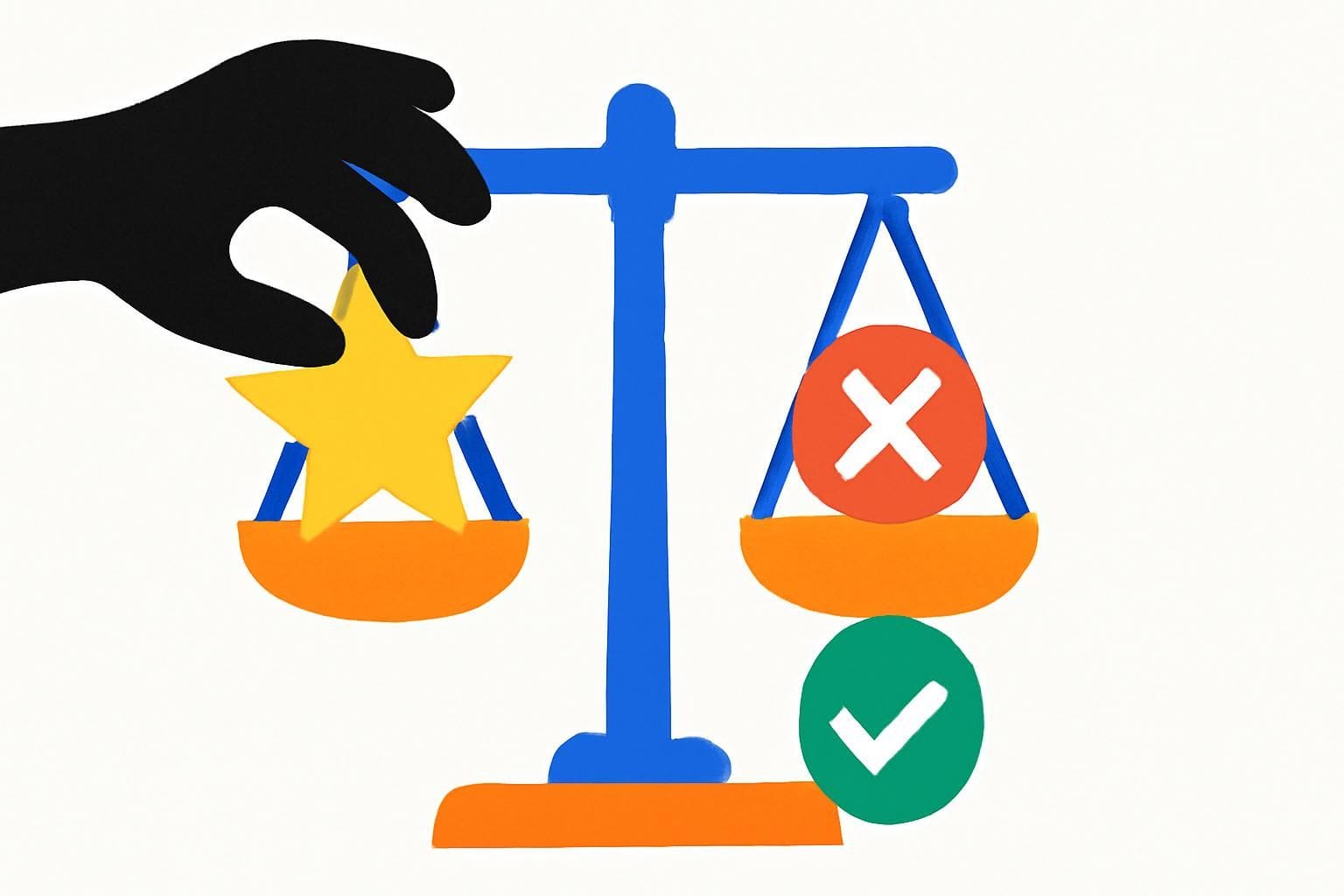
Also prepare your responses to likely objections: cost, internal time, and return on investment. The more you plan ahead, the more confidence you inspire. To refine your presentation and communication plan, this guide on the definition and tools of online reputation provides solid guidance. As Warren Buffett once said, it takes twenty years to build a reputation and five minutes to ruin it. Your ten-minute presentation will determine which way the scales tip.