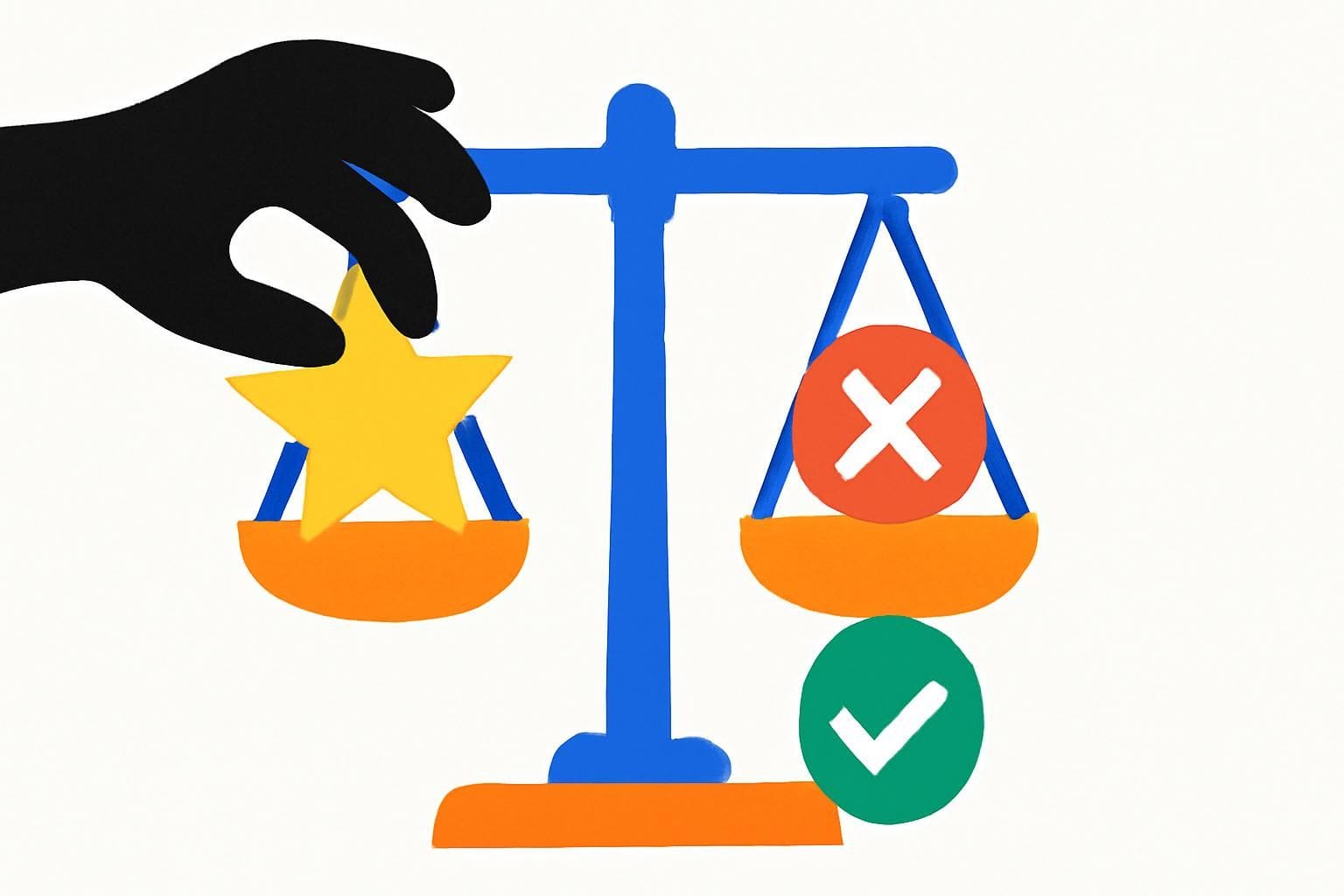
A 4.8-star rating on Google can justify a 10- to 15% price increase without driving customers away. This is the core of the connection between online reputation and psychological pricing. A 2024 BrightLocal study shows that 87% of consumers check reviews before choosing a local business, and that they’re willing to pay more when they see a high rating. This guide breaks down how customer trust impacts your profit margin, with real-world examples from tradespeople and retailers. The problem: too many businesses are selling their services at rock-bottom prices when their reputation would actually allow for much more profitable premium pricing.
In short:
- A rating higher than 4.7 stars serves as a sign of quality that allows for premium pricing without losing sales volume.
- Perceived value takes precedence over the listed price: a customer who feels reassured is less likely to shop around or haggle.
- A psychological price works best when it is backed by strong social proof.
- In the GEO era, generative AI primarily recommends companies with high brand recognition.
- Every lost star comes at a high cost: neglecting your online reputation means handing your market share over to competitors.
Online Reputation and Psychological Pricing: The Combination That Boosts Your Margins
Yes, a good online reputation allows you to charge more. A customer who sees a 4.8-star rating associates that rating with low risk, and that sense of security is worth its weight in gold. They’re buying peace of mind as much as the product itself.
The psychological price is based on a simple idea: consumers don’t think like calculators. When faced with a price, they feel it before they calculate it. A price of €49.90 rather than €50 triggers the perception of a good deal, even if the actual difference is only ten cents. This emotional mechanism, described in detail in this analysis of psychological pricing to boost sales, is significantly amplified when social proof reassures the buyer.
Take Karim, a plumber in Toulouse. For years, he priced his services the same as his competitors, convinced that price was the deciding factor. By managing his Google listing and earning a 4.9-star rating based on 140 reviews, he was able to raise his service rates by 12%. The result: fewer calls from price-sensitive customers and more customers booking his services because they trust him.
This shift can be explained by mental anchoring. When a prospect sees a high rating before even looking at the quote, their brain adjusts their expectations. They no longer ask themselves, “Is this too expensive?” but rather, “Is this professional worth the price?” The answer is already written in the yellow stars displayed on their business profile.
Customer trust acts as a price buffer. A Lyon bakery renowned for its pastries can sell its croissants for twenty centimes more than the chain next door. No one complains, because the reviews and enthusiastic comments have already established the quality in the customer’s mind. Price becomes secondary compared to the promised experience.
Be careful, however, not to fall into the opposite trap. A price that’s too low combined with an excellent rating can raise suspicion. Consumers may wonder where the catch is. Consistency between your positioning, your rating, and your pricing structure builds credibility. It is this harmony that transforms your reputation into a sustainable source of profit margins.
How Google Ratings Influence Perceptions of a Fair Price
A Google rating sets a benchmark in the customer’s mind before they even look at your prices. A high rating raises the price threshold they consider acceptable. It’s a powerful—and free—anchor.
This mechanism aligns with the principles outlined for calculating psychological pricing online. The acceptable price is not fixed; it fluctuates based on trust signals. A company with a 4.2-star rating and another with a 4.8-star rating trigger two completely different psychological price ranges for the same service.
Sarah, a freelance hairstylist in Bordeaux, realized this by observing her clients. Ever since she’s had a 4.8-star rating, her new clients no longer object to the higher price for highlights. They come in already convinced. The reviews praising her successful hair color jobs have done the work of convincing them even before their appointment. We break down this dynamic in our guide to online reputation for hairstylists.
The comparison effect also plays a decisive role. A prospective customer who compares three service providers on Google Maps will often immediately rule out the one with a rating below 4 stars, regardless of their price. The selection is based on trust before budget. Your rating becomes a screening criterion, not just a selling point.
Premium Pricing: Build Perceived Value Before Announcing the Price
Premium pricing isn’t something you just declare—it takes preparation. You need to establish the perceived value in the customer’s mind well before revealing the price. Reviews, photos, and responses to comments do this groundwork in advance.
Perceived value stems from an accumulation of subtle cues. A comprehensive Google Business Profile, professional photos, thoughtful responses to reviews, and a high reputation score: every detail reinforces the impression that you’re worth more. This groundwork then determines the elasticity of your prices. To measure this dynamic, see our definition of the reputation score.
In the field, we consistently observe one thing when working with business owners. Businesses that respond to 100% of their reviews—even the negative ones—enjoy greater price tolerance. Customers don’t just judge the rating; they judge how you handle dissatisfaction. A business owner who calmly responds to a critical review inspires more trust than a perfect rating with no interaction at all.
Here’s how different reputation levels affect your billing capacity:
| Google rating | Customer Perception | Pricing flexibility |
|---|---|---|
| Less than 3.5 stars | Caution, intense comparison | Mandatory minimum price |
| 3.5 to 4.2 stars | Neutrality, hesitation | Alignment with the Competition |
| 4.3 to 4.6 stars | Moderate confidence | Premium Light accepted |
| 4.7 to 5 stars | Strong trust, reassurance | Premium pricing of 10 to 20 percent |
A body shop owner in Lyon said he had hesitated to raise his prices for fear of losing customers. After reaching a 4.8-star rating, he tried a subtle price increase. No customers left, and his revenue went up. The mistakes to avoid in this line of work are discussed in our article on online reputation for auto repair shops.
The lesson is clear: set the emotional stage before talking about money. A customer who feels confident about the quality is less likely to haggle and less likely to shop around.
Use Your Google Reviews in Sales Meetings
Your Google reviews aren’t just there to spruce up your listing—they’re powerful closing tools. Showing a screenshot of your best reviews during a meeting instantly puts the prospect at ease and defuses price objections.
An architect we’ve been following incorporated these reviews into his sales presentation. When faced with a client who thought his fees were too high, he showed testimonials from clients who were delighted with the added value of his work. The discussion shifted from price to quality. This approach, applicable to many professions, is explored in our analysis of reputation and sales closing.
Social proof shifts the balance of power. When a prospect reads that about ten customers found your service “well worth the price,” they imagine themselves feeling the same satisfaction. Your past customers are doing the selling for you. That’s the true power of a pricing strategy built on customer trust.
Pricing Strategy and the Influence of Reviews: The Risk of Ruining Everything
A poor pricing strategy combined with a fragile reputation can destroy your credibility in a matter of weeks. The influence of reviews works both ways: it supports a justified premium, but it severely punishes any discrepancy between promise and reality.
Psychological pricing remains a double-edged sword. As this discussion on psychological pricing—whether as a conversion tool or a reputational risk—highlights, a tactic perceived as manipulative breeds mistrust. A customer who feels cheated by a fake “strikethrough price” or a false sense of scarcity will say so in a review. And that review will permanently damage your rating.
Let’s imagine a restaurant owner who artificially inflates their listed prices in order to offer permanent discounts. At first, it works. Then a savvy customer calls out the ploy in a scathing review, others follow suit, and the rating plummets. What was meant to be a conversion tool has backfired, damaging the restaurant’s reputation. Consistency between your pricing message and the actual experience remains non-negotiable.
The costs of a tarnished reputation go beyond simply losing customers. A wary supplier, a cautious banker, a candidate hesitant to join your company—the damage extends far beyond immediate revenue. We’ve documented this reality in our report on the hidden costs of a poor online reputation.
Conversely, every star counts toward your valuation. A business that loses half a star often sees its flow of leads decline. We quantify this impact in our study on how much one fewer star on Google costs. The message is clear: your rating is a financial asset, not just a decorative badge.
Good business discipline involves aligning three elements: your price point, your review score, and the actual experience you deliver. When these three pillars align, the premium becomes legitimate and sustainable. When they diverge, the consequences follow quickly.
The GEO Era: When AI Chooses Your Competitors for You
Generative engines prioritize recommending businesses with high brand recognition and good ratings. If your online reputation remains poor, the AI will naturally steer the customer toward a better-rated competitor—without you ever knowing it.
GEO—this optimization for artificial intelligence—is changing the rules of digital marketing. When a user asks, “Which reliable plumber is near me?”, the AI assistant analyzes the available data. It prioritizes businesses with numerous positive reviews and flags reports of negative experiences. Your rating becomes an automated selection criterion.
This trend makes managing online reputation a matter of urgency. A business that doesn’t appear in AI-generated recommendations disappears from the purchasing equation. Customers no longer even compare it—they simply don’t see it. Tracking the right metrics becomes vital, as explained in our guide to online reputation KPIs.
Reputation also has financial value. A buyer considering an acquisition of an SME now scrutinizes its rating and reviews before signing—a process described in our article on due diligence and digital reputation. Building a solid reputation means protecting your ability to charge more today and increasing your company’s value tomorrow.
Building a Sustainable Premium Pricing Strategy Through Customer Trust
A premium pricing strategy is sustainable when it is based on regularly collecting reviews and delivering an impeccable customer experience. Trust can’t be bought—it’s built review by review, month by month.
The first step is to make the request for reviews a systematic process. A satisfied customer often forgets to leave a review if not asked to do so. A simple invitation, sent at the right time, increases the number of positive reviews. This volume, combined with a high rating, forms the foundation of your perceived value and, therefore, your pricing power.
Here are the pillars of a reputation that provides lasting support for premium pricing:
- Consistency of data collection: A steady stream of new reviews carries more weight than a one-time spike followed by silence.
- Responding to all reviews: Each response demonstrates your commitment and humanizes your brand.
- Handling Negative Reviews: When handled professionally, they paradoxically build trust.
- Value for money: Your pricing structure should accurately reflect the experience promised in the reviews.
- Up-to-date photos and content: a dynamic product page builds trust and justifies a premium positioning.
Let’s take another look at Sarah’s journey—she’s a hairstylist in Bordeaux. In eighteen months, she went from 60 to 220 reviews, with an average rating that has stabilized at 4.8. Her clientele has changed: fewer casual bargain hunters, more loyal customers willing to pay for consistent service. Her profit margin has increased even though her hourly volume has remained the same. Customer trust has done the job that price cuts could no longer accomplish.
Psychological pricing remains a valuable ally in this strategy, provided it is used with finesse. Techniques for increasing sales through psychological pricing are most effective when backed by an authentic reputation. An appealing price of €197 instead of €200 works better when supported by a review that reassures customers about the actual quality of the service.
Government authorities themselves recognize the influence of reviews on purchasing decisions—a topic we covered in our article explaining how the French government discusses reviews and reputation. This institutional recognition confirms what is already evident on the ground: reviews now shape the local economy.
The bottom line is crystal clear. Investing in your online reputation means buying the freedom to set your own prices. A company with a 4.8-star rating no longer has to endure price wars—it avoids them altogether. It sells peace of mind, which price alone can never fully justify. Charging more isn’t pretentious; it’s the fair reward for trust that has been earned and nurtured.