In a nutshell: the “reputation first” model reverses traditional business logic. Instead of designing an offer and then looking for customers, successful companies scrutinize what their buyers write to shape their products, services and messages. With 87% of consumers consulting reviews before a local purchase (BrightLocal, 2024) and generative AIs now relying on reputational signals to recommend a brand, ignoring the customer voice is tantamount to offering market share to competitors.
- The customer’s voice becomes a strategic raw material for building the sales offer
- Google reviews and third-party platforms now feed answers to generative AIs
- An average rating below 4.2 stars reduces the click-through rate on Google Maps by 35%.
- Brands that practice active listening turn detractors into ambassadors
- Acquisition costs drop by 30-50% for companies that structure their offer around customer feedback
Why reputation is becoming the starting point for all commercial offers
Reputation has become the foundation on which a viable offering is built. Even before the first line of a business plan, existing customer feedback, or that left to the competition, dictates profitable areas of differentiation. The market no longer forgives offers that are disconnected from the field.
For decades, brands developed their value proposition in hushed meeting rooms, then tried to sell it. The model has been reversed. Today, a Lyon-based restaurateur opening a new establishment begins by scouring 300 Google reviews of his direct competitors within a two-kilometer radius. He detects recurring irritants (slow service at lunchtime, lack of vegetarian options, unclear bill) and builds his concept by responding point by point. This method transforms criticism into free specifications.
The figures bear out this intuition. According to the Whitespark Local Search Ranking Factors 2024 study, the quality and quantity of reviews now account for almost 17% of local rankings on Google. An artisan bakery in Bordeaux saw its sales jump by 22% in six months after reformulating its pastry offer around the three most frequent compliments left by its customers: “home-made”, “additive-free”, “grandma’s recipes”. No new products were created, just targeted promotion.
The voice of the customer as a living specification
Every comment posted online contains strategic information. A plumber in Toulouse who carefully reads his reviews discovers that his customers value punctuality more than price. He then adjusts his communication, highlights his guaranteed time slots and charges 8% more without losing a customer. Reputation dictated pricing.
This active listening requires discipline. Monthly monitoring of recurring keywords in reviews (positive and negative) reveals trends that conventional marketing research takes six months to detect. Reputation monitoring tools automate this collection and facilitate semantic analysis.
When generative AI reshuffles the market cards
The massive arrival of AI assistants in the purchasing journey is changing the game. When an Internet user asks ChatGPT, Perplexity or Gemini “which is the best plumber in Toulouse”, the answer is based on the consolidation of public reputation signals. A company with 4.8 stars and 200 detailed reviews will be cited. Its competitor with 3.9 stars and 40 reviews will disappear from the conversational radar.
Building your offer on the basis of opinions: the field method
Building a “reputation first” offering is based on a simple loop: collect customer feedback, analyze it, extract recurring patterns, then adapt products, services and communication. This loop unfolds continuously, not once a year at a strategy seminar.
The first step is to map the sources of expression. Google Business Profile captures 73% of local reviews according to the BrightLocal 2024 study, but TripAdvisor, Trustpilot, Yellow Pages, specialized forums and social networks contain qualitative nuggets. An independent hairdresser in Nantes discovered in a local Facebook group that his customers especially appreciated the calm of his salon. He turned this into his main line of communication, christening his offer “noise-free haircut”. The result: a reputation that has spread far beyond his neighborhood.
The second step is structured analysis. Classifying feedback by theme (quality, price, welcome, lead times, atmosphere) then quantifying occurrences reveals real strengths and blind spots. This reading grid becomes a steering tool. A car garage in the Paris region identified that 38% of its positive reviews mentioned “clear explanations of repairs”. It transformed this practice into a signature service, called “transparent diagnosis”, and invoiced it separately. Margin increased by 14% over 12 months.
| Step | Concrete action | Measurable benefits |
|---|---|---|
| Collection | Centralize multi-platform reviews | 360° vision of perception |
| Semantic analysis | Identify 10 recurring keywords | Detecting real forces |
| Adapting the offer | Reformulating products and messages | Increase in conversion rate (+15 to 30%) |
| Storytelling | Integrating verbatims into communication | Enhanced credibility with prospects |
| Return loop | Solicit new targeted opinions | Strengthening reputational SEO |
Customer feedback as marketing raw material
Using customers’ exact words in communication media produces an authenticity that even the best advertising copy can’t match. A hotelier in La Rochelle replaced all his room descriptions on his website with extracts from verified reviews. The direct booking rate rose by 19% in four months. The phrases aren’t polished, but they ring true.
Reputation and generative AI: the new competitive battleground
Generative AI relies on public reputational content to recommend a brand. A company with a poor rating or few comments becomes invisible in conversational responses. The battle is no longer waged solely on Google, but extends to all the conversational agents that filter consumer attention.
The phenomenon has been documented. A Search Engine Land study published at the end of 2024 shows that LLMs give priority to companies with a significant volume of reviews (over 100) and a rating above 4.3. Below this threshold, brands rarely appear spontaneously. AIs aren’t mean, they’re just statistics. They give priority to signals of accumulated trust.
This new reality is forcing managers to rethink their investments. Sponsoring a Google Ads campaign without taking care of your Google Business Profile is like pouring water into a leaky bucket. A dental practice in Lille redirected 40% of its advertising budget towards the structured collection of reviews and the personalized response to each comment. Six months later, its inbound traffic via AI assistants accounted for 12% of new appointment bookings, a channel non-existent the previous year.
Anticipate rather than suffer weak signals
Detecting a deterioration in perception before it goes viral is a game-changer. Predictive reputation approaches spot tonal inflections from the very first negative comments. A franchised bakery chain avoided a major crisis by identifying three reviews of the same failed batch in a single establishment. Reaction within 48 hours, training for the staff concerned, transparent communication. The rating stabilized.
From customer feedback to sustainable value creation
Sustainable value creation occurs when listening to customers becomes an institutionalized process, not a one-off reflex after a bad note. Lasting brands transform feedback into a structural competitive advantage. They no longer react, they anticipate expectations.
The customer experience is conceived as a complete cycle. Each point of contact (quotation, delivery, after-sales service, billing) generates a measurable signal. A regional ready-to-wear retailer has installed a post-purchase survey system sent 72 hours after checkout. Feedback is fed directly into store managers’ briefings. In 18 months, the re-purchase rate has risen by 27%. Trust is built on regular feedback, not on one-off communication campaigns.
Transparency plays a central role. A brand that responds publicly and sincerely to reviews signals to future customers that it takes quality seriously. A Michelin-starred restaurateur in Saint-Émilion personally responds to every review, negative or positive, within 24 hours. This discipline has earned him a rating of 4.9 out of 412 reviews. When a customer is deciding between two establishments, it’s this level of visible commitment that makes the difference.
Steering by reputation indicators
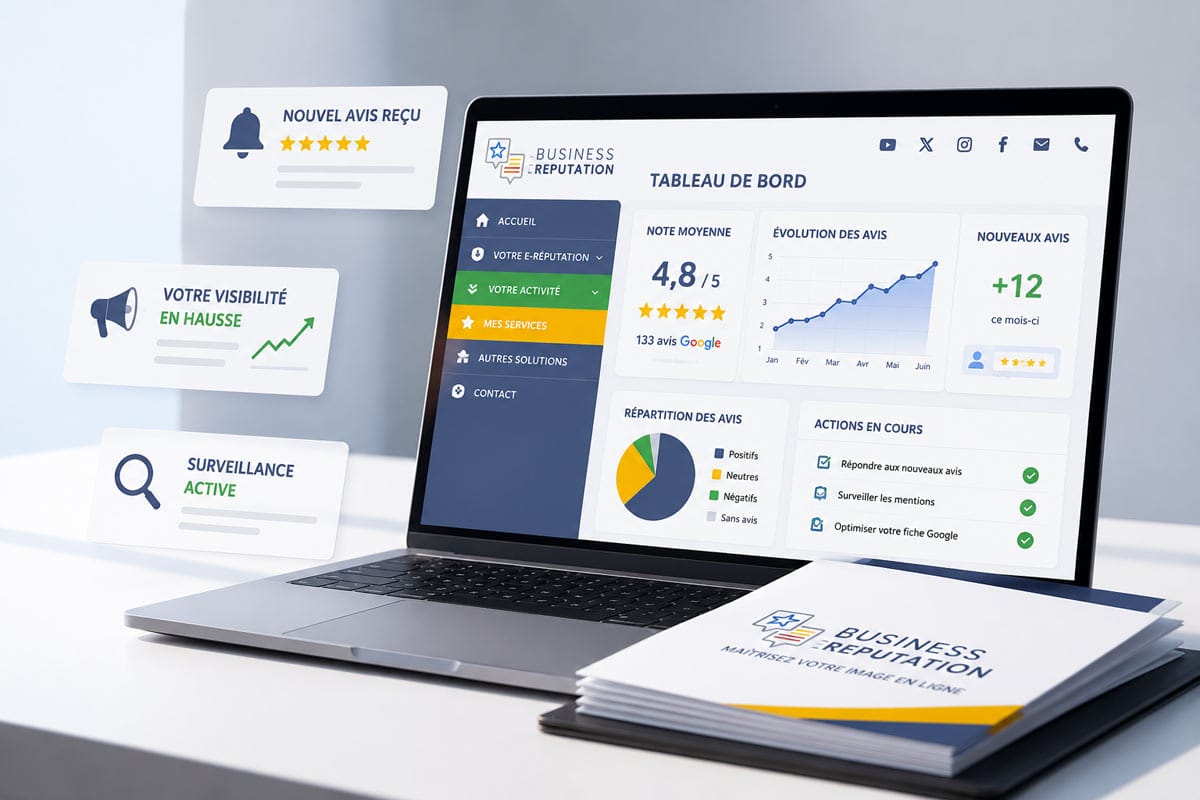
Measuring what counts requires the right tools. A reputation dashboard consolidates essential metrics: average rating, monthly review volume, response rate, prevailing sentiment, share of voice versus competitors. This monthly management tool avoids blind spots and guides budgetary decisions.
Implementing the reputation first model in an SME
Deploying this model in an SME requires neither a huge budget nor a dedicated team. Three resources are all that’s needed to get started: a committed manager, an in-house person trained in opinion leadership, and a weekly analysis routine. The rest you learn as you go.
The first classic mistake is to outsource reputation management entirely to an agency. In this case, the manager loses direct contact with his customers, which is precisely what is most valuable. An empowering approach, such as that described in the guide to managing your Google reputation yourself, offers a better return on investment. The skills acquired remain with the company and feed the sales strategy over the long term.
The second mistake is to confuse quantity and quality of reviews. Soliciting 500 customers at once by sending an automatic link generates hollow comments (“super”) that help neither SEO nor market understanding. A personalized solicitation, formulated after a clear positive moment (successful delivery, problem solved), produces rich verbatims that shed light on areas for improvement and win over future prospects.
The time investment is reasonable: 2 hours per week for an independent business, 4 to 6 hours for a multi-site SME. The return on investment can be seen as early as the third month, in the quality of incoming leads. Prospects arrive better informed, less negotiating, more aligned with the real offer. The sales cycle is mechanically shortened.
| Company profile | Weekly effort | First visible result |
|---|---|---|
| Independent trade | 2 hours | +15% local traffic in 3 months |
| Multi-site SMEs | 5 hours | Average rating +0.4 stars in 6 months |
| Franchise network | 8 hours (head office coordination) | Harmonization of brand perception over 12 months |
The stakes go beyond marketing. A brand built on genuinely listening to its customers develops resilience in the face of crises, a capacity for continuous innovation and organic loyalty. This is no longer an option for ambitious companies; it’s the playing field for tomorrow’s competition. Ignoring this lever is tantamount to letting competitors write their own story, and yours by default.