A bakery in Lyon lost 30% of its reservations in a single weekend. The reason? Three negative reviews posted on a Friday evening, which weren’t noticed until Monday morning. This story, seen time and again in the field, sums up the importance of online reputation monitoring for a small business in 2026. Monitoring what’s being said about your brand is no longer a luxury reserved for agencies: 92% of internet users check reviews before buying from or contacting a business. This comparison of free and paid monitoring tools shows you what to choose, at what price, and how to avoid discovering a crisis too late.
In short:
- Automated customer review monitoring saves valuable time and defuses crises before they escalate.
- Free solutions (Google Alerts, Talkwalker Alerts, Webmii) are enough to get started with online reputation management without a budget.
- Paid solutions (Mention, Brandwatch, Semrush, Hootsuite) providesentiment analysis and real-time monitoring.
- The right tool depends on the scope of the sources, noise filtering, and integration with your processes.
- With generative AI, low-rated brands are being excluded from recommendations: monitoring the landscape has become a matter of business survival.
Why Online Reputation Monitoring Has Become Vital for a Very Small Business
Online reputation monitoring involves continuously tracking everything that’s being said about your company on the web and social media. For a very small business, it protects credibility, helps anticipate crises, and turns customer feedback into a driver of growth. Without it, you’re flying blind.
The web never sleeps. A dissatisfied customer might post a comment at 11 p.m. on a Sunday, and that message takes on a life of its own while you’re closed for the night. Manual monitoring—relying on ad-hoc Google searches—leaves huge blind spots. It’s precisely in these blind spots that negative buzz takes root.
The Hidden Cost of Ignoring a Negative Review
Let’s take the example of a plumber in Toulouse. A customer leaves a scathing review on his Google listing: no warning about a delay, vague estimate. The plumber doesn’t see it for three weeks. During that time, the review climbs up the local rankings and discourages about ten potential customers. A single poorly handled review can cost several thousand euros in revenue.
Online reputation management allows you to respond within an hour. Responding quickly, calmly, and with facts often turns a critic into a customer who respects your professionalism. Response time makes all the difference between an isolated incident and a viral crisis.
Perception as a Strategic Backbone
Building your digital image provides a framework for all your marketing efforts. A brand that listens adapts its messaging, identifies major trends in customer feedback, and strengthens the connection between what it promises and what it delivers. This consistency builds trust and fosters loyalty.
The advent of AI-powered search engines is a game-changer. When a consumer asks a smart assistant, “What’s the best auto repair shop near me?” the AI draws on reputation and ratings to make a recommendation. Highly rated businesses come out on top, while the others fall by the wayside. Implementing a robust online reputation monitoring strategy is becoming a business necessity, not just a nice-to-have.
One final piece of advice based on real-world experience: business owners who monitor their reputation on a daily basis weather crises much better than those who react in a panic. Consistency beats improvisation every time.
Free Solutions for Getting Started with Monitoring on a Tight Budget
For a small business, a freelancer, or a company trying out its first monitoring initiative, there are several free solutions that cover the most visible mentions. Google Alerts, Talkwalker Alerts, and Webmii make up a solid trio to get started without spending a penny.
These tools aren’t a substitute for a professional platform, but they’re more than enough for a bakery, a hair salon, or a consulting firm just starting out. The key is to lay the groundwork before moving up to a higher level.
Google Alerts: Simplicity Above All Else
Google Alerts remainsthe most accessiblemonitoring tool on the market. You enter the name of your brand, your executives, or your competitors, and the search engine sends you an email as soon as a new indexed page mentions those terms. It takes just two minutes to set up and is completely free.
Its limitation: it mainly covers websites, blogs, and news articles, while largely ignoring social media. For a florist in Bordeaux who wants to know if a local article mentions their shop, it’s perfect. To track a controversy on Instagram, you’ll need to look elsewhere.
Talkwalker Alerts: The More Comprehensive Alternative
Talkwalker Alerts takes coverage a step further. It incorporates social media and news feed monitoring, with an interface that allows you to filter by language or source type. The result: less digital noise and more relevant alerts.
A restaurant owner in Lyon uses it to track mentions of his establishment on food forums and a few social media platforms. He cross-references these alerts with his own monitoring of customer reviews to make sure nothing slips through the cracks. This free combination already covers 80% of a local business’s needs.
Webmii: Personal Reputation Assessment
When a company’s reputation depends on its founders or experts, Webmii becomes invaluable. It scans the web for mentions by name and assigns a visibility score. It’s ideal for checking whether outdated or embarrassing information appears in the top search results.
An independent consultant discovered this when he typed his name into the search bar: an old, closed legal case still appeared in third place. Without this tool, he would never have known that his prospects were coming across it before even contacting him. For more information, resources detail the best free tools and their professional alternatives.
The lesson behind these free tools can be summed up in one sentence: starting small is a thousand times better than doing nothing. Just because something is free doesn’t excuse inaction.
Comparison of Paid Tools for Advanced Monitoring
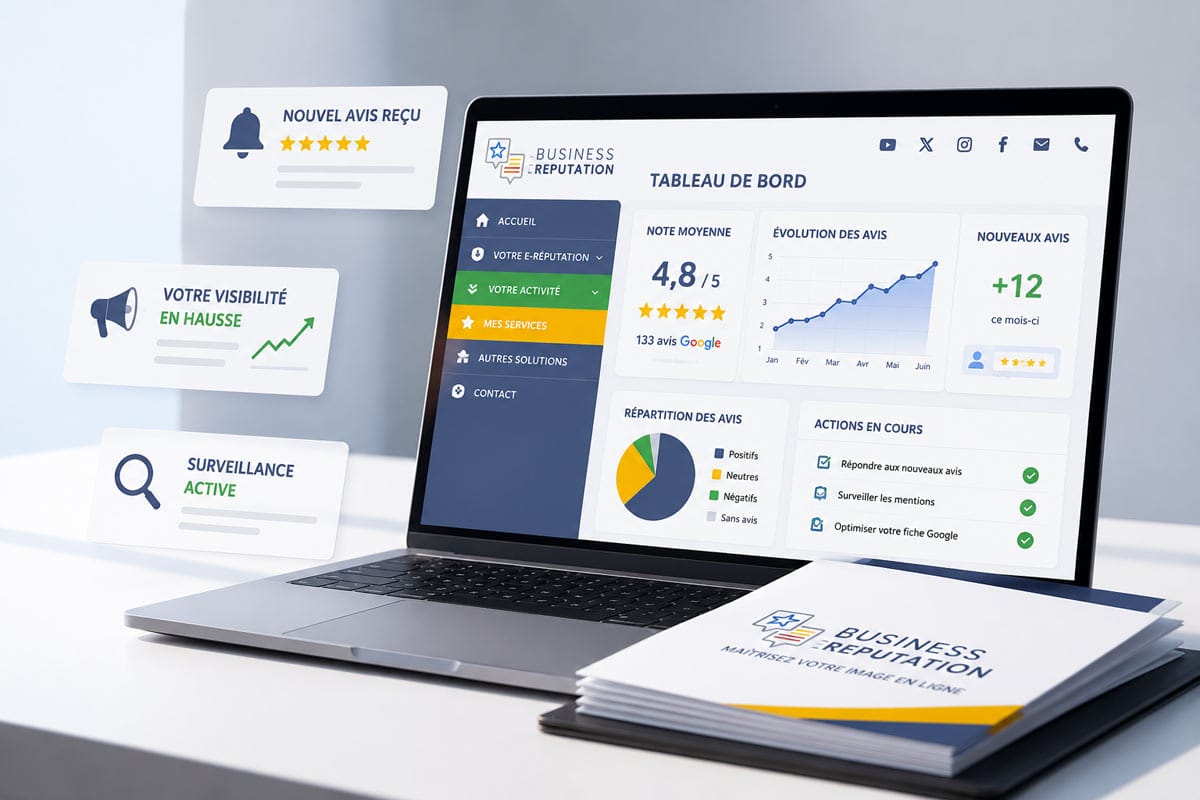
As soon as the volume of mentions increases or the financial stakes become significant, paid solutions take over. They offersentiment analysis, comprehensive dashboards, and real-time monitoring across millions of sources. Here is a comparison of the leading tools on the market.
| Tool | Strengths | Target Audience |
|---|---|---|
| Brandwatch | Accurate sentiment analysis, advanced data visualization | Major Accounts and Agencies |
| Note | Modern interface, collaborative team management | SMEs and Marketing Services |
| Semrush | Direct link to SEO and competitive intelligence | SEO and Growth Managers |
| Hootsuite | Centralization of Social Media Monitoring and Posting | Social media managers |
Note: Real-time monitoring
Mention is one of the most well-rounded tools available. It continuously scans millions of sources and stands out for its collaborative features. You can assign a specific mention to a colleague, who can respond directly from the interface—this prevents duplication and ensures a consistent message.
An e-commerce SME with three customer service representatives uses it to distribute responses without stepping on each other’s toes. Each person handles their own alerts, while the manager maintains an overview. This seamless workflow justifies the subscription as the team grows.
Brandwatch: Artificial Intelligence for Brand Image Management
Designed for large organizations, Brandwatch uses artificial intelligence to segment conversations, identify weak signals, and anticipate emerging trends. Its granular reporting by region or topic makes it an essential tool for international multi-brand companies.
A franchise network with 40 locations uses it to compare how its stores are perceived city by city. Management can thus identify when a particular region is seeing a concentration of complaints about delivery times and take action before the problem tarnishes the brand’s national image. In this regard, maintaining control over an online reputation across multiple locations requires a dedicated approach.
Semrush and Hootsuite: SEO and Social Media Combined
Semrush links online reputation monitoring to SEO. You can track your brand mentions while monitoring your rankings and those of your competitors. The connection between brand image and visibility becomes clear, which is why an SEO agency should also manage your brand mentions.
Hootsuite, on the other hand, centralizes social media monitoring and posting in a single dashboard. For a community manager juggling five platforms, this time-saving feature makes a real difference in their day-to-day work. Detailed overviews compare these professional solutions based on user profiles.
The right approach: Pay only for what you’ll actually use. An underutilized, high-powered tool is still an expense, not an investment.
How to Choose the Right Market Intelligence Tool for Your Small Business
Choosing a monitoring tool depends first and foremost on your specific goals, not on the number of features. Three criteria stand out: source coverage, filtering quality, and integration with your processes. Evaluate these before subscribing.
A common pitfall: giving in to the allure of an all-in-one platform when three free tools would do the trick. Simplicity often pays off better than sophistication.
Source Coverage and Noise Filtering
Some tools excel on traditional websites but don’t support Instagram or TikTok. If your customers are active on visual platforms, check to see if the necessary APIs are available. A B2C cosmetics brand doesn’t have the same needs as a law firm, for which monitoring the trade press is a top priority.
Filtering is just as crucial. Receiving 500 alerts a day is pointless if you have to read them all. A good tool filters out duplicate mentions and prioritizes them by tone: a red alert on a high-traffic site takes precedence over a neutral, inconsequential mention.
Workflow Integration and Taking Action
Check to see if there’s a mobile app and whether it can send notifications to Slack or Microsoft Teams. Being able to turn an alert into a response without switching tabs is a real productivity boost for a small team.
To help you get started, the online reputation starter kit for small business owners offers five steps you can complete in less than two hours. It’s enough to lay a solid foundation without getting bogged down in technical details.
Preparing for a Crisis with a Clear Protocol
Even the best tool is worthless without the right approach. Define a simple response matrix:
- Who responds to a negative Google review, and within what timeframe?
- Who speaks out when there is a controversy on social media?
- What tone to use: factual, calm, and never defensive.
- What thresholds trigger an escalation to management?
- How to document each incident to learn from it.
Technology detects; people solve. Supplementing these tools with regular competitive intelligence further refines your understanding of the market. Consistency in monitoring remains the key to a lasting brand image, especially in the face of AI systems that recommend the top-rated options and ruthlessly weed out the rest.