In a nutshell: Google Business Profile has undergone a metamorphosis. The classic business card has given way to a veritable local marketing hub, powered by artificial intelligence, with 54 new sector attributes, enriched messaging and LLM-driven algorithmic reading. Merchants who miss out on these levers automatically leave their place to better-prepared competitors. Here are the highlights to remember before diving into the details:
- 54 new sector attributes added by Google to refine local relevance by micro-specialty.
- Search by functionality is gradually replacing search by broad category.
- Generative AIs (ChatGPT, Gemini, Perplexity) draw on Google Business Profile to formulate their local recommendations.
- 93% of searches with local intent display a local pack: ignoring its listing is like closing your storefront.
- Native messaging andcall history turn the form into a direct conversion channel.
Google Business Profile in 2026: what has really changed since Google My Business?
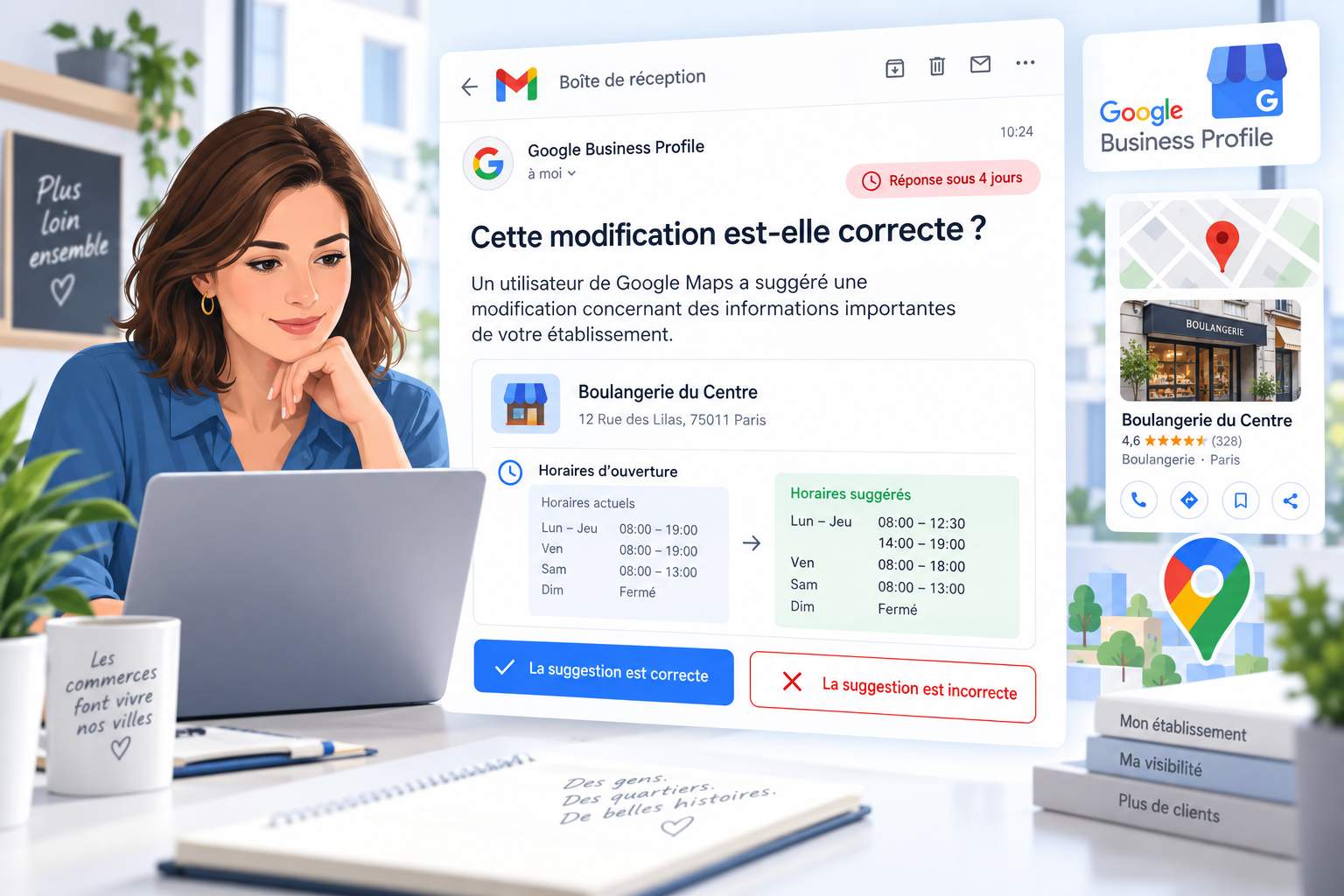
The switch from Google My Business to Google Business Profile has reshuffled the cards in local SEO. Today, the business profile can be managed directly from Google Search and Google Maps, without a dedicated application, with a layer ofartificial intelligence that analyzes in real time the consistency of information, the frequency of publications and the quality of customer interactions.
The facts on the ground are clear: merchants who still manage their listing as they did in 2020 are losing traffic to those who exploit the new bricks and mortar. A baker in Lyon who updates his photos every week, responds to reviews within 24 hours and uses specific attributes (gluten-free, natural sourdough bread, click and collect) captures three times as many clicks as a neighboring bakery stuck on its opening hours.
The major shift lies in the semantic reading of index cards. Google no longer simply compares keywords. The algorithm now evaluates the density of engagement, the diversity of media published, the freshness of posts and the regularity of responses. A Parisian restaurateur who publishes a weekly post with his or her dishes of the day and responds to every review (even the laconic 5 stars) signals to Google a healthy business. Conversely, a listing that hasn’t been published for six months is interpreted as a dormant or even closed business.
The end of the static file, the era of the living profile
A Google Business Profile in 2026 is more like a mini-site than a digitized paper directory. Tabs dedicated to services, products, Q&A, special offers and events transform the listing into an interactive showcase. A plumber in Val-d’Oise who details his indicative rates, adds before-and-after photos of his jobs and offers a button for making direct appointments converts twice as well as a colleague who relies solely on digital word-of-mouth.
Thestructural upgrade to Business Profile has also simplified multi-branch management, thanks to the Business Profile Manager, which can be accessed without the need for extensive installation. A hairdressing chain with twelve salons in the Provence-Alpes-Côte d’Azur region manages the entire business from a single interface, with fine-tuned delegation of rights per establishment.
New sector attributes: the silent revolution in local SEO
Google has injected 54 new attributes in 2026 to refine the relevance of local results. These attributes range from sedation dentistry to peaceful river walks, from tattoo artists specializing in cover-ups to restaurants serving raw vegan dishes. The logic behind this is to enable Internet users to search not for a broad category, but for a specific functionality.
This granularity changes the game for retailers who control their positioning. A veterinary clinic that ticks the attributes “NAC consultation”, “night emergencies” and “long-term hospitalization” appears on hyper-specific queries that its generalist competitors don’t even capture. This is exactly what theanalysis of the 54 new local relevance attributes describes: the concept of the “multi-faceted” business redefines the local pack.
In concrete terms, here are the families of attributes that deserve immediate attention:
| Attribute family | Concrete examples | Impact on visibility |
|---|---|---|
| Accessibility | PRM entrance, adapted sanitary facilities, disabled parking | Captures 8 to 12% of additional requests |
| Business specializations | Sedation, tattoo cover-up, gluten-free cooking | Queries with very high purchase intent |
| Payment methods | Contactless, crypto, payment in instalments | A decisive filter for young buyers |
| Atmosphere and experience | Quiet, Romantic, Family oriented, Sports oriented | Direct influence on clicks to the file |
| Additional services | Click and collect, delivery, appointments | Boost your action-sheet conversion rate |
Check the right attributes without falling into the trap of over-marking
Beware of the “I tick everything to be everywhere” syndrome. Google detects inconsistencies. A small café that ticks “reception room for up to 200 people” when its surface area is 40 m² is liable to be flagged and lose algorithmic confidence. The golden rule: only tick what is tenable and verifiable. Attributes must reflect the reality of the business, not a marketing projection.
A regular audit of checked attributes, ideally on a quarterly basis, allows you to adjust the file to changes in the offer. To get to the heart of the matter, the Google Business Profile glossary details each field and its influence on local ranking.
Generative artificial intelligence and the new battle for online visibility
The massive arrival of conversational AIs in the buying journey is redrawing the rules of the game. When a consumer asks ChatGPT, Gemini or Perplexity “the best Italian restaurant in Bordeaux open on Sunday lunchtime”, these models draw their answers from a mix of Google Business Profile records, aggregated reviews and third-party sources. Brands with the best digital reputation come out on top. Those with repeated negative feedback are cited as counter-examples or simply discarded.
This mechanism, known as GEO (Generative Engine Optimization), transforms e-reputation into a strategic asset. A recent BrightLocal study shows that 87% of consumers consult reviews before choosing a local merchant. With AI, this consultation becomes implicit: the user no longer reads the reviews, but receives a pre-packaged recommendation directly. If your listing has a 3.6-star rating, with reviews mentioning slow service, the AI will mention this in its response, sometimes word for word.
The field confirms the urgency. An osteopathy practice in the suburbs of Lyon saw its flow of new patients drop by 22% in six months after a wave of three detailed negative reviews. The cause: ChatGPT systematically recommended two better-rated colleagues nearby. It took four months of intensive work to collect qualified reviews and respond to criticisms.
Prepare your file to be quoted by generative models
LLMs like structured data, factual answers and consistent opinions. Three concrete levers to maximize your chances of being quoted:
- Maintain an average rating of over 4.5 stars with a significant volume of reviews (over 80 reviews for a downtown business).
- Respond to every review, negative or positive, with natural, personalized language that signals an active human presence.
- Enrich the data sheet with verifiable factual content (precise timetables, detailed services, dated photos) that serves as raw material for AIs.
For merchants wishing to manage this aspect on their own, the guide to Google reputation management without an agency or SaaS details the weekly routines to put in place.
Messaging, calls and conversion: interaction tools that few use
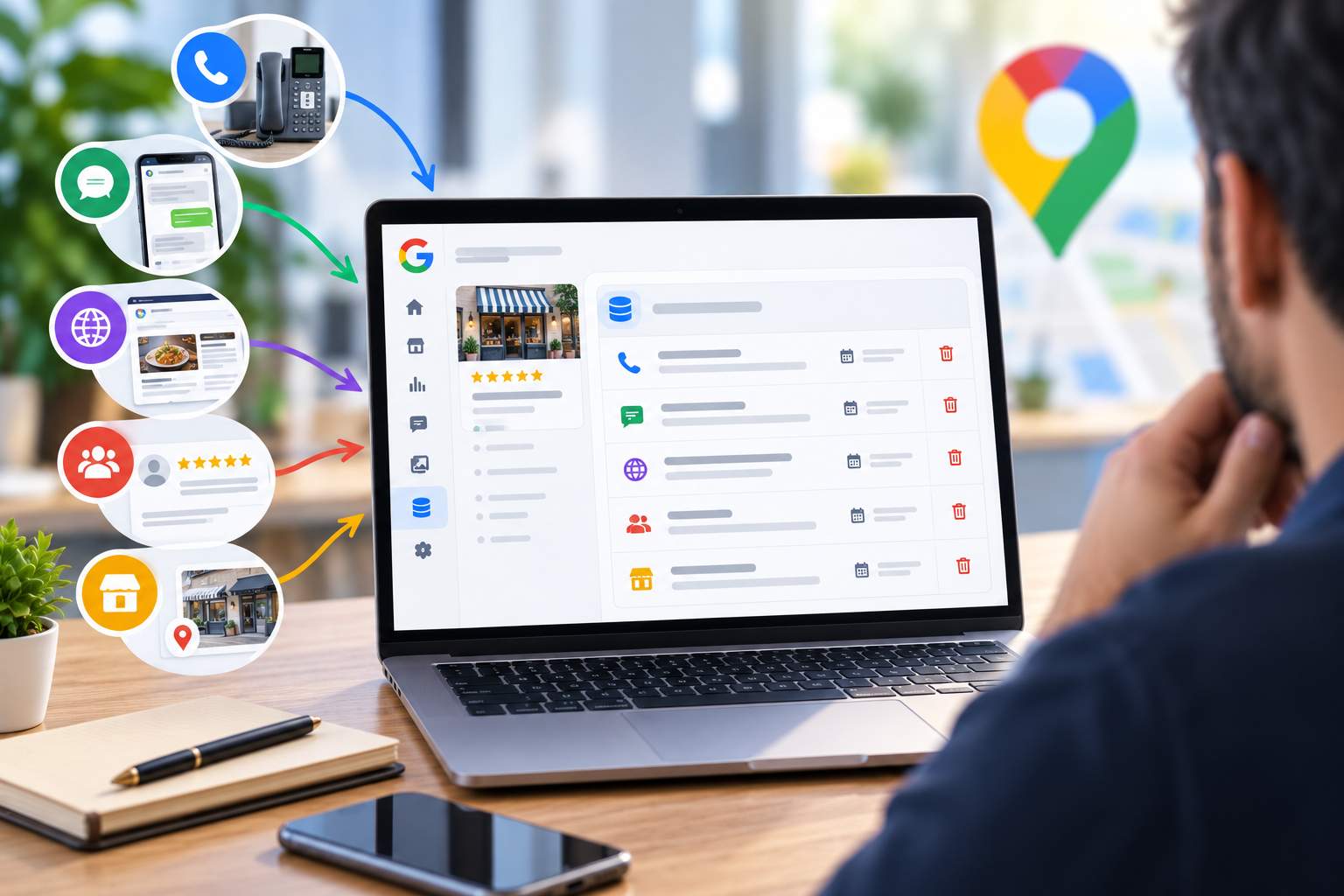
The company card has become a genuine direct sales channel. Native messaging, already present on Google Maps, is now being deployed on Google Search, with a reading charge and conversation history.Call history, long reserved for the North American market, is gradually arriving in France, providing access to caller numbers, call duration and pick-up rates.
This data changes the retailer’s posture. A florist in Toulouse discovered from her call history that 38% of her missed calls occurred between 12pm and 2pm, when her staff went to lunch. A simple adjustment to the opening hours brought these lost customers back into the conversion tunnel. Without this data, the problem would have remained invisible.
As far as reviews are concerned, intelligent collection remains the key to success. A QR code positioned at the checkout, on the restaurant bill or in the post-sales confirmation email multiplies the volume of reviews collected by a factor of five on average. The Google review link generator with QR code can be set up in just a few minutes, with no technical skills required.
Integrated data analysis to manage local visibility
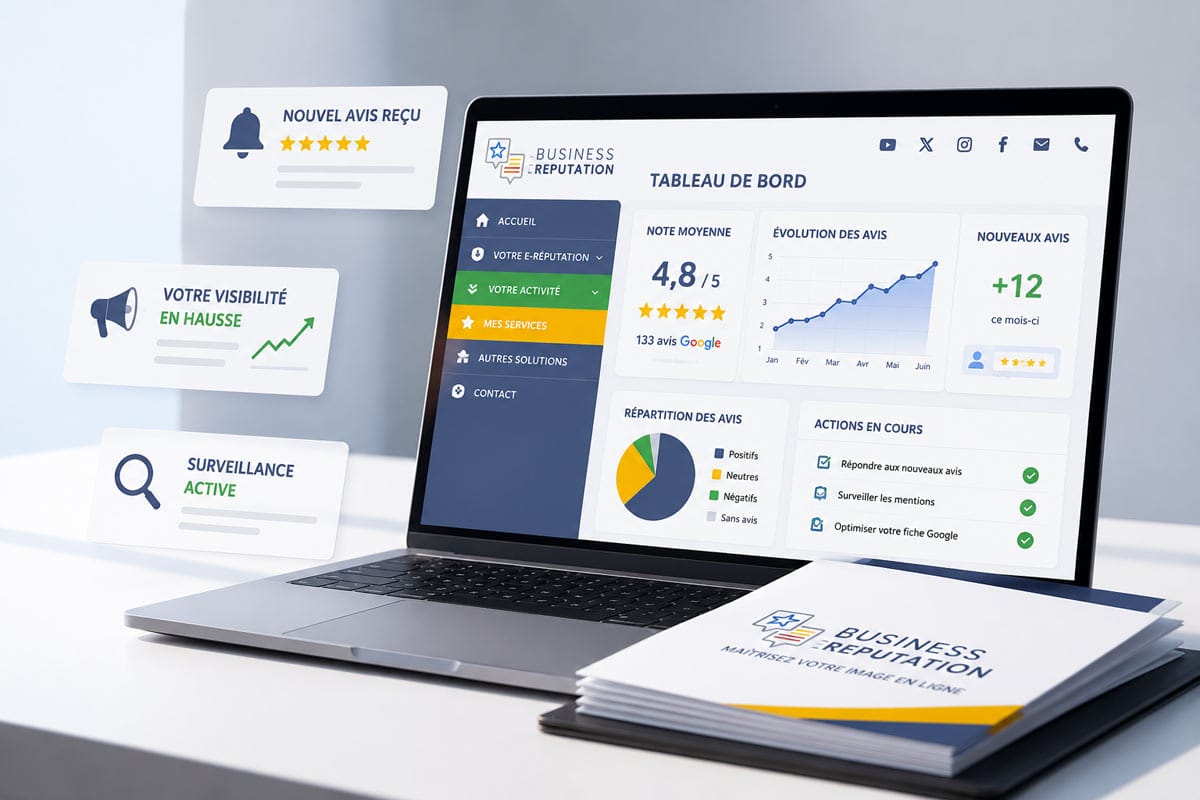
Business Profile’s integrated dashboard provides valuable indicators: number of views, queries used to find the listing, actions taken (call, itinerary, site visit), photos consulted. By cross-referencing this data with seasonal variations, you can adjust your publication strategy, promotions and opening hours.
A case in point: an electric bike rental company on the Atlantic coast found that its peak requests were appearing on Thursday evenings, two days before the arrival of weekend tourists. By scheduling its promotional posts for Thursday at 6 p.m. rather than Saturday morning, the company increased the number of clicks to its reservation module by 31%. The data existed. Nobody was looking at it.
Photos, videos and visual content: the invisible fuel of local SEO
A Google Business Profile listing without regular photos is now penalized. The algorithm values visual freshness and media diversity. Listings that publish at least four new photos per month record an average 42% more itinerary requests than static listings, according to field observations compiled by several local SEO agencies.
Beyond volume, it’s technical quality that counts. Bright, well-framed photos, geotagged if possible, accompanied by their own metadata. AI-generated visuals are beginning to enter the game, provided they remain consistent with the reality of the location. A ready-to-wear boutique that publishes totally fanciful AI-generated visuals runs the risk of being reported by a disappointed user on the spot. The resources on SEO photos optimized for Google Business Profile detail current best practices.
Short videos (15 to 30 seconds) are also gaining in popularity. A motorcycle repair shop in the Paris region publishes a weekly 20-second mini-video showing an accelerated repair. As a result, its engagement rate on the form exceeds the industry average by 60%. Internet users see know-how, not just a description.
The hanging plug trap and preventive protection
With the multiplication of functionalities, the risk of suspension increases. A merchant who changes his legal name without supporting documents, who changes his address too frequently, or who finds himself the victim of a malicious report, may find his listing blocked overnight. The loss of visibility is immediate and brutal. To anticipate this, our complete guide to recovering a suspended Google Business Profile lists the steps to take, step by step.
Prevention also requires competitive intelligence. Some unscrupulous merchants orchestrate campaigns of false negative reviews to sabotage their rivals. The procedure to follow in the face of such attacks is documented in the analysis dedicated to situations where a competitor leaves false reviews, with the evidence to be gathered and the legal remedies available.
To structure the technical data transmitted to Google and AI, adding Schema.org markup to the website remains a valuable complement. LocalBusiness’s JSON-LD schema generator simplifies this step, often overlooked by non-technical merchants. The analyses published by Actif Digital on 2026 functionalities confirm that the convergence between listing, site and structured data is becoming the unavoidable standard for inclusion in local results.
What you remember:
- The 54 new attributes open up ultra-targeted queries that your competitors are not yet exploiting.
- Generativeartificial intelligence rewards active, well-rated and well-documented entries.
- Messaging, call history and integrateddata analysis transform the form into a direct sales tool.
- Fresh photos, short videos and systematic responses to reviews boost online visibility.
- Without ongoing e-reputation work, your market share will slide towards businesses better prepared for AI-assisted local search.