Google Business Profile categories: the parameter that silently decides whether your listing appears in the local top 3 or disappears behind your competitors. With over 4,000 categories available in the Google repository, and a BrightLocal 2024 study showing that 84% of consumers trust online reviews as much as personal recommendations, this choice becomes a strategic lever for local SEO. A baker in Lyon who changes his name from “boulangerie” to “boulangerie-pâtisserie artisanale” can see his Maps traffic jump by 30% in just a few weeks. This guide details how to choose, prioritize and bring your Google categories to life.
In a nutshell:
- The main category weighs much more heavily than the secondary categories in the local algorithm.
- Google offers over 4,000 categories, but only 10 can be used per listing (1 main + 9 secondary).
- The wrong category can suspend your listing or drop it in the Local Pack.
- Secondary categories are used to cover peripheral services, without diluting the core business.
- Regular audits of competing categories remain the most reliable method of staying competitive.
Categories Google Business Profile: definition and role in local SEO
A Google Business Profile category is an official label describing a business’s activity. It tells the Google algorithm what type of queries should trigger the display of your listing. Without it, your business profile remains invisible to local searches, even with ten years of service and 500 five-star reviews.
The system is based on a taxonomy fixed by Google. You can’t invent a category. You have to choose from a pre-established list that is regularly expanded, sometimes with haphazard French translations (the famous “courtier en prêt hypothécaire” actually refers to real estate broker). This nomenclature covers very precise activities: “French restaurant”, “Italian restaurant”, “gourmet restaurant”, “traditional restaurant”… it’s up to you to identify the one that best suits your real positioning.
Why this label weighs so heavily in the algorithm
The Local Pack algorithm cross-references three main signals: relevance (your main category is the mainstay), distance and reputation. Without a category aligned with the user’s query, the other two criteria are useless. A Parisian florist categorized as “gift store” will never come up with “florist 11th arrondissement”, even if it’s right in the heart of the district.
In the field, our experience with retailers in the Paris region shows that 70% of under-performing listings have an incorrectly calibrated main category. Diagnosis takes five minutes, correction fifteen, and the effect is often felt within the first week. For a complete definition of the role of these labels, the GBP category glossary details the mechanics of the algorithm.
The classic mistake: confusing declared profession with perceived profession
An artisan carpenter in Bordeaux had self-registered as a “construction company”. Logical on paper. Except that his customers were typing in “joiner Bordeaux” or “parquet installer Bordeaux”. Result: a phantom listing. Changing the main category to “carpenter” and adding “parquet installer” as a secondary category multiplied incoming calls by 2.4 in six weeks. The customer’s perception of the trade always takes precedence over the trade registered with the RCS.
How to choose your main Google Business Profile category
The main category should reflect your dominant activity, the one that generates the most sales and corresponds to your customers’ first search intention. It’s the one that triggers the most relevance signals from Google, and determines the functionalities available (reservations, menu, quotes, dishes).
The most reliable method is based on three simple steps: identify the main query typed by your customers, check the categories of the first three Local Pack competitors on this query, and choose the most specific formulation available from the Google list. The more specific the category, the better. “Pizzeria” beats “Italian restaurant” which beats “restaurant”.
Analyze the competition before deciding
No tool can replace direct observation. Type in your target query on Google Maps, click on the first three results and note their visible categories (the main one is displayed under the name of the establishment). If the three leaders are in “pizzeria” and you’re in “Italian restaurant”, you know what you have to do. Extensions such as GMB Everywhere or PlePer allow you to extract this data en masse.
This analysis also reveals niche opportunities. In certain saturated local markets, a slightly offbeat (but sincere) main category can offer visibility that the obvious category refuses. For example, a hairdresser specializing in beards in Marseille will gain more by positioning himself as a “barber” than as a “hair salon”, despite lower overall demand: competition there is ten times less aggressive.
When precision becomes a trap
Hyper-specialization has its limits. Choosing “raw vegan restaurant” when you also serve cooked dishes drastically reduces your exposure. The practical rule: the main category should describe the activity you want to grow. If you’re launching a new line and want to push it, align the main category. If you want to consolidate what already exists, stick to the mature business.
Secondary categories: cover all your services without diluting your listing
Secondary categories allow you to add up to nine additional descriptors to cover services peripheral to your business. They broaden the spectrum of queries captured without modifying the weight of your main category in the algorithm. Their impact is real, but considerably less than that of the main category.
The most common mistake is to pile up categories in the hope of visibility. A garage owner who adds “body shop”, “technical inspection center”, “tire sales”, “service station”, “car rental” and “breakdown service” without actually offering these services confuses the signal sent to Google and risks suspension. Consistency takes precedence over completeness.
The 3 to 5 relevant categories rule
Experience gained from several hundred optimized listings indicates that a reasonable number of secondary categories is between three and five. Anything less and you leave visibility on the table. Beyond that, you dilute the signal and risk attracting an unqualified clientele who will end up leaving mixed reviews because they haven’t found what they were looking for.
A case in point: a beauty salon in Nantes offered hairdressing, aesthetics, manicures, facials and waxing. Rather than stacking the five, the strategy chosen was “beauty salon” as primary, then “manicure”, “hairdressing salon” and “waxing center” as secondary. Facials were pushed via attributes and photos, not via a category. Result: +18% views on the listing in two months.
Prioritize without wasting space
Here’s how to structure your choices according to the type of activity:
| Type of activity | Recommended main category | Useful secondary categories | Pitfalls to avoid |
|---|---|---|---|
| Italian restaurant in Paris | Pizzeria or Italian restaurant | Catering, Takeaway, Wine bar | Combine “restaurant” + “Italian restaurant”. |
| Artisan plumber | Plumber | Heating engineer, Sanitary fitter, Emergency service | Add “construction company” too broad |
| Law firm | Lawyer | Employment law lawyer, Family law lawyer | Select all legal specialties |
| Barber | Barber (if positioning) | Hair salon, Men’s hair salon | Beauty salon” too generic |
| Car garage | Car repair shop | Body shop, Tire sales, Inspection center | Add “dealer” without being one |
Secondary categories also play a role in the filters displayed by Google Maps. A well-categorized listing appears in searches filtered by type of service, multiplying the points of entry to your business profile.
Modify categories without risking suspension of listing
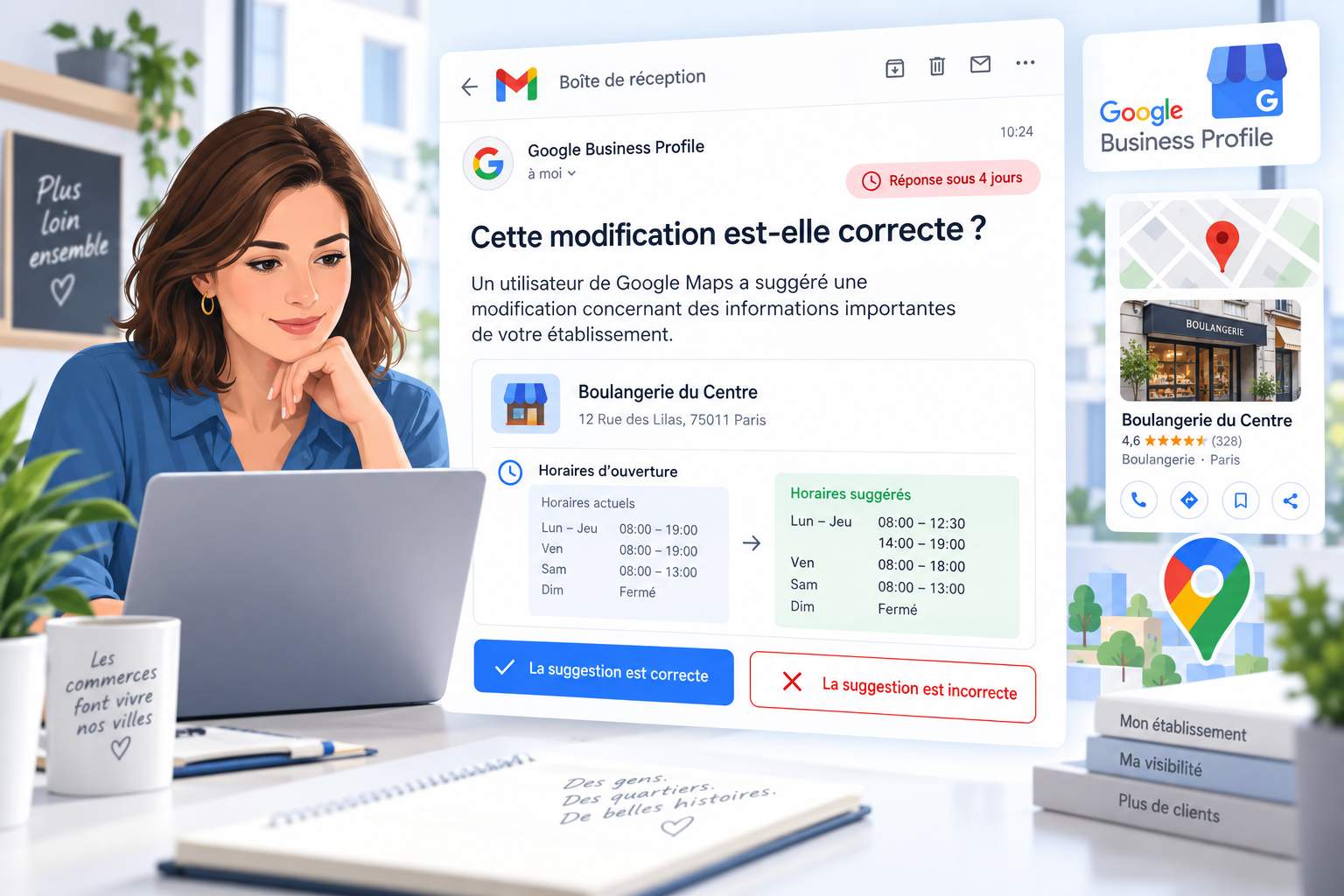
Changing the main category of a Google Business Profile listing can trigger a recheck by Google, especially if the change is radical. To limit the risk, proceed in gradual stages, keep proof of activity to hand and avoid multiple modifications over a short period.
The frequency of suspensions has increased since the tightening of the algorithm in 2023, confirmed by recent changes in Google policy. It can take several weeks for a suspended listing to come back, or even never to return if the reactivation request is poorly set up. The guide to recovering a suspended Google Business Profile details the step-by-step procedure.
Secure modification procedure
Here is the sequence to follow to modify your categories without damage:
- Connect to your Google Business Profile interface via Google search or Google Maps.
- Click on “Modify file”, then on the “Activity category” section.
- Change only one category at a time if you’re touching the main one. Wait 7 to 10 days between major changes.
- Add secondary categories one by one, validating each one.
- Monitor the insights over the following two weeks to measure the real impact.
An often overlooked point: if you manage several establishments, never suddenly synchronize all categories in bulk. Google interprets this type of action as a suspicious automated signal and may suspend all listings at once. Multi-establishment management requires planning over several weeks.
Case study: a change that transformed a form
An independent wine shop in Toulouse was classified as a “wine and spirits store”. Its direct competition (two national chains) occupied the first three places in the Local Pack. The move to the main “caviste” category (a more specific, less crowded category) and the addition of “fine wine store” and “wine tasting” as secondary listings propelled the listing to position 2 on “caviste Toulouse” within three weeks. No other changes were made during this period, isolating the effect of the categories.
Categories Google and visibility in the age of AI searches
With the rise of generative AI-assisted searches (SGE, Gemini, ChatGPT Search, Perplexity), the category declared on your Google Business Profile becomes a structuring signal for response engines. AI models rely heavily on Google’s structured data to identify relevant local players to recommend in their answers.
In concrete terms, when a user asks an AI “what’s the best vegetarian caterer in Lyon?”, the model partly queries Google’s local graph, where your categories act as a first filter. A poorly categorized listing simply disappears from the scope considered by the AI. To understand the stakes involved in this new paradigm, the analysis of visibility in AI responses provides a comprehensive overview.
The triple filter of IA engines
LLMs apply a three-stage filter when recommending a local establishment: categorical relevance (does your listing match the query?), quality signal (average rating, volume of reviews, freshness), and external trust signals (mentions on other sites, consistency of data). If the first step fails, the other two don’t take place. Your 4.9 rating is useless if the category doesn’t match.
This mechanism explains why players who worked on their categorization as early as 2024-2025 are now capturing AI traffic disproportionate to their size. They are “readable” for the models. The others remain invisible in the new conversational interfaces, even when they perform well in traditional search.
Anticipating tomorrow’s local SEO factors
Recent developments in local SEO in 2026 confirm that consistency between declared category, services actually offered, website content and customer reviews is becoming the decisive factor. A merchant who declares himself to be a “gourmet restaurant” but whose reviews speak of a “nice, inexpensive brasserie” is sending out a contradictory signal that AIs detect immediately. The competitor who aligns his entire ecosystem takes his place.
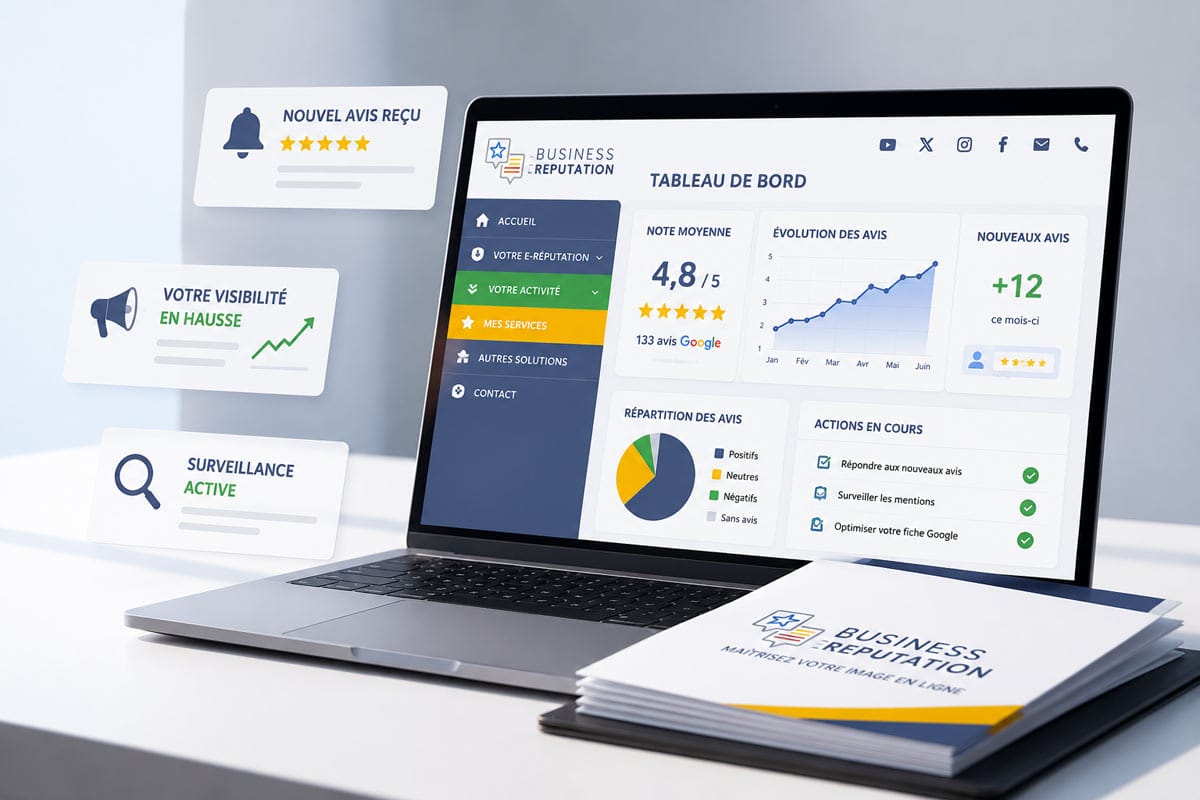
For merchants who want to keep a firm grip on their strategy, independent Google reputation management remains largely accessible, provided they understand the underlying mechanics. Google’s free tools are sufficient in 90% of cases, provided they are used in the right order. The classic trap is to focus on collecting reviews before you’ve locked in the foundations, including categories.
The final point that separates the top performers from the rest is consistency. A category chosen in 2022 is not necessarily the right one in 2026. Search behaviors evolve, Google labels become more refined, new categories appear (the “specialized coffee shop” category didn’t exist five years ago). A quarterly category audit takes thirty minutes and can reveal a major opportunity. It’s probably the local SEO action with the best time/impact ratio available today.