False Google reviews of a competitor: a single misleading review can result in the loss of 30 to 70 calls per month, depending on the sector, and a BrightLocal 2024 study shows that 88% of consumers consult reviews before choosing a local business. This article details the practical steps to follow: gather evidence of a fraudulent review, trigger an effective Google alert, mobilize the right legal recourses (DGCCRF, defamation, unfair competition) and protect your online reputation in the long term against an unfair competitor.
In a nutshell: False review attacks have exploded since the arrival of generative engines that rely on brand awareness and customer feedback to recommend a brand. Here are the key points to bear in mind:
- First and foremost, freeze the evidence: time-stamped captures, complete URLs, court commissioner’s report if justified by the commercial stakes involved.
- Qualify the notice before taking action: false commitment, denigration, defamation or blackmail do not call for the same recourse.
- Targeted Google reporting: cite the rule violated, provide factual clues, avoid vague requests.
- Three legal avenues: DGCCRF for misleading commercial practices, civil court for unfair competition, libel suit if a specific fact is imputed.
- Never reply with false positive reviews: penalty of up to €750,000 fine and 5 years’ imprisonment online.
Recognizing a fake review left by a competitor: the signals that don’t deceive
A fake review posted by an unfair competitor has recognizable markers. The author’s account often displays zero photos, an empty history or a series of reviews published in distant cities within a few hours. The text sometimes mixes criticisms incompatible with your real business, or quotes a service you don’t offer.
In the field, retailers who consult an e-reputation specialist often describe the same scenario. A bakery in Lyon saw its rating drop from 4.7 to 4.1 in ten days after a competitor opened 300 meters away. Seven negative reviews published in two weeks, all from accounts created in the same month, all mentioning “badly baked bread” with almost identical wording. The stylistic signature betrays coordination.
Technical clues add up quickly when you know what to look for:
- Google accounts without profile pictures or using generic avatars
- Notices published in short bursts (less than 72 hours)
- Repetitive vocabulary from one notice to the next (same adjectives, same expressions)
- Systematic 1-star ratings without nuance or verifiable detail
- Mention of a product or service that you do not market
- Notices posted at unlikely times for a real customer (3 a.m.)
- Authors who also rate your direct competitor positively
Detection was refined in 2026 thanks to the Polygraphe tool deployed by the DGCCRF, which analyzes massive volumes of notices to identify statistical anomalies. Investigators now have a cross-checking capacity that far exceeds what a retailer can do alone. To find out more about the precise legal definition, please refer to our glossary of terms, which details the criteria used by French courts.
A final signal deserves attention: coincidence in time. If the wave of fraudulent notices occurs just after the opening of a competitor, a commercial dispute or the departure of an employee, the body of evidence is considerably strengthened. It is exactly this type of chronology that enables us to move from a mere suspicion to a case that can be brought before a judge.
Build up a solid file of evidence before any appeal
Before reporting or attacking, the first priority is to preserve evidence. A fraudulent notice can disappear at any time, modified by its author or deleted by Google without notice. Without a dated archive, the case falls apart. This step determines the rest of the procedure.
The professional method relies on several layers of complementary evidence. A personal screenshot is rarely enough to stand up in court: it can be contested as well as manipulated. The winning reflex is to combine several mutually reinforcing sources of proof.
Documents to collect within the first 48 hours
Here is the operational checklist used by online litigation lawyers:
| Type of proof | Detail to keep | Legal value |
|---|---|---|
| Screenshots | Full URL, date, time, review, author profile, overall rating | Indicative, to be reinforced |
| Court commissioner’s report | Official notice and background minutes | Indisputable proof |
| Sales history | CRM, invoices, diary: absence of the alleged customer | Demonstrates absence of relationship |
| Messages received | SMS messages, threatening e-mails or requests for postponement prior to notification | Establishes possible blackmail |
| Comparative analysis | List of other notices with the same profile and their targets | Reveals a coordinated pattern |
| Business impact | Drop in calls, cancelled quotes, comparative sales | Estimate the loss |
A commissioner’s report costs between 250 and 600 euros, depending on its complexity. This may seem high for a single notice, but it becomes unavoidable as soon as several suspicious comments accumulate, or if the commercial loss exceeds a few thousand euros. A specialized Parisian law firm reports that a well-constructed case is successful in around 70% of summary proceedings against Google.
Document the link with the suspected competitor
Identifying an unfair competitor requires methodical investigation. Cross-referencing publication dates with the suspect’s commercial activity, comparing IP addresses if they have been leaked, observing positive reviews posted by the same accounts on your rival’s site: everything converges towards a cluster of clues. Kohen Avocats details the evidentiary methodology applicable in commercial court.
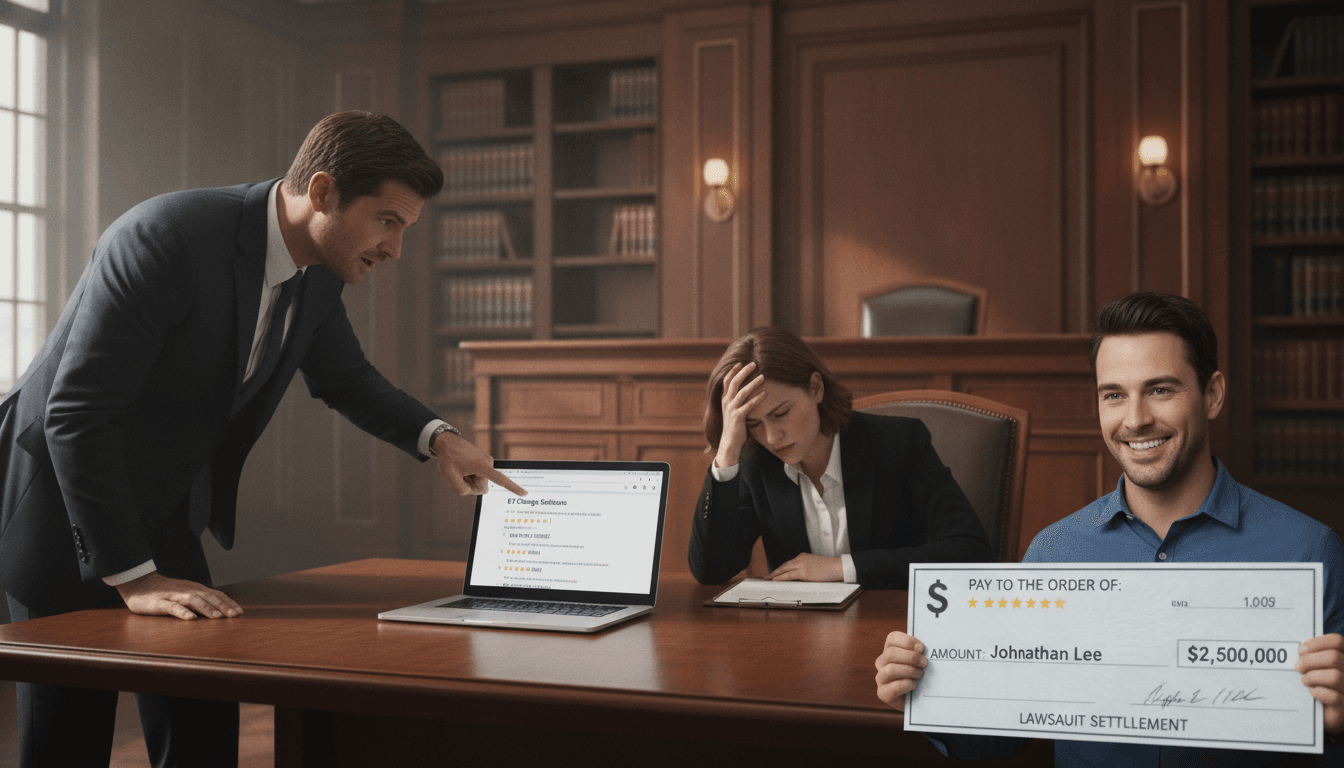
A plumber in the Val-de-Marne region of France succeeded in convicting a competitor by demonstrating that three fraudulent reviews had come from accounts that had all rated the same rival positively within a 5 km radius. The detailed evidence was enough for the judge to order the withdrawal and award 8,000 euros in damages.
Google reporting: the procedure that really works
Google reporting only works when it is based on a specific platform rule. A generic “this review is fake” request has a 90% chance of being rejected. A request that cites the fake engagement policy, provides verifiable clues and explains the conflict of interest triples its chances of success.
Google recognizes several categories of non-compliant reviews: false engagement, conflict of interest, off-topic content, harassment, misleading statements, illegal content. Each category triggers a different analysis grid on the moderation side. So it’s important to choose the right entry point from the outset.
Write an alert that will be read
Google moderators deal with thousands of reports every day. Clear, structured, factual text is given priority. Emotional or accusatory text ends up in the bottom pile. The recommended structure consists of four blocks:
- Identification: direct link to notice, publication date, rating, full text copied
- Rule violated: explicitly cite the relevant Google policy (false commitment, conflict of interest, etc.).
- Factual clues: absence of customer in CRM, suspicious profile, coordinated series, duplicated vocabulary
- Specific request: withdrawal of notice and, if relevant, review of other notices of the same profile
For multi-establishment records, the reflex is to report from the main Google Business Profile dashboard, which has a slightly higher priority channel. The average processing time oscillates between 3 and 14 days in 2026, with a noticeable acceleration when the report comes from an account that has been verified for several years.
When reporting fails: formal notice
If Google does not withdraw the notice within two to three weeks, the next step is to send a formal notice to Google Ireland Limited, the European entity. This registered letter, drafted by a lawyer, sets out the precise legal grounds and points out that Google would incur liability as a host by maintaining manifestly illicit content after notification. Deshoulières Avocats explains the nuances of anonymity with regard to fraudulent notices.
Public response remains a delicate subject. Many entrepreneurs give in to the temptation of responding to a fake review. This reaction gives visibility to the comment and can backfire if the response itself imputes an unproven fact. A sober response is preferable:
“We are unable to find any files matching your comment in our customer database. Please contact us directly to verify the situation and provide an appropriate response.”
This neutral line reassures future customers who read the exchange, without fuelling controversy. The overall protection strategy against false reviews is based on this discipline of tone.
Legal remedies against an unfair competitor: DGCCRF, defamation, unfair competition
There are three distinct legal grounds for attacking false reviews. Choosing the right one depends on the perpetrator identified, the content of the notice and the objective pursued (removal, compensation, criminal sanction). An effective strategy often combines several avenues in parallel.
Leveraging the DGCCRF and SignalConso
The Direction Générale de la Concurrence, de la Consommation et de la Répression des Fraudes deals with misleading commercial practices as defined in article L. 121-4 of the French Consumer Code. Distributing false reviews or having them distributed, modifying reviews to promote a product, asserting without verification that reviews come from real consumers: all these constitute an offence. Penalties are up to 2 years’ imprisonment and a €300,000 fine, increased to 5 years and €750,000 when the offence is committed online.
Reporting is done via the SignalConso platform , the DGCCRF’s official portal, which centralizes reports and triggers targeted investigations. The advantages of this approach are twofold: it costs the victim company nothing, and it can lead to administrative or criminal sanctions against the unfair competitor, creating a lasting dissuasive effect in the sector.
Unfair competition proceedings before the Commercial Court
When two companies are involved in a commercial dispute, the Commercial Court has jurisdiction. An action for unfair competition is based on three classic elements: fault (publication or organization of false notices), damage (loss of sales, damage to image) and the causal link between the two. Summary proceedings can be used to quickly obtain the removal of content and protective measures.
In a ruling handed down on March 14, 2025, the Paris Court of Appeal confirmed that an anonymous article full of errors published about a competitor constitutes both a misleading commercial practice and an act of unfair competition. This dual qualification opens the door to substantial compensation claims, especially when the company documents the damage precisely. Politano Avocat develops this legal articulation.
Defamation and identification of the anonymous author
If the notice imputes a specific, verifiable fact (“this company invoices fictitious services”, “the boss steals from his suppliers”), the qualification of defamation becomes relevant. Beware of the extremely short limitation period: 3 months from publication. After that, the action is extinguished.
In a summary procedure, Google can be forced to disclose the anonymous author’s connection data (IP address, date, time). Once identified, the competitor can be attacked directly. This procedure takes between 4 and 8 weeks in the Paris region, and is quicker when the case is solid. Cases of cyber-extortion via false Google reviews fall under criminal law, with a complaint to the public prosecutor.
Anticipating and protecting your online reputation in the face of generative AI
Legal protection remains a curative response. The real defense against unfair competitors is built upstream, with a strategy of authentic reviews that makes attacks visible and ineffective. A listing that goes from 200 to 800 verified reviews automatically dilutes the impact of 5 false negative comments.
The challenge takes on a new dimension with the arrival of generative engines. ChatGPT, Perplexity, Gemini and Claude rely heavily on reputation signals to recommend a local business. When an Internet user asks for “the best dentist in Bordeaux”, the AI ranks establishments by cross-referencing the average rating, volume of reviews, freshness of comments and consistency of multi-platform signals. An under-rated business simply disappears from the algorithmic recommendations.
Building an opinion base that absorbs attacks
Merchants who have been actively collecting reviews for more than two years are much less affected by attacks. The ratio counts: 10 false negative reviews drowned in 600 authentic 4.8-star reviews barely affect the final rating. The same attack on a file of 80 reviews causes the average to plummet to 3.9.
Good collection practices revolve around three principles:
- Psychological timing: ask for advice at the precise moment of maximum satisfaction, as studied in our analysis of the ideal moment to ask for advice.
- Diversification of channels: QR code at checkout, post-sales SMS, NFC, automated email, etc.
- Regularity: a constant flow is better than a one-off campaign that arouses Google’s suspicions.
Monitor other platforms to anticipate coordinated attacks
A competitor who attacks on Google often also attacks on Facebook, Yellow Pages, TripAdvisor or Trustpilot. Multi-platform monitoring can detect an organized campaign before it does too much damage. Managing multi-platform reviews is becoming an indispensable reflex for any locally visible company.
On the Facebook side, the removal procedure follows a similar logic, but with its own specific features, detailed in our guide to removing a fake Facebook review. The guiding principle remains the same: proof, qualification, structured reporting, legal escalation if necessary.
Regulatory developments and new tools 2026
A European Commission study published in 2024 estimates the proportion of suspicious reviews on major platforms, across all sectors, at 25%. The Digital Services Act strengthens the obligations of European hosting providers, who must now deal with reports within strict deadlines, on pain of heavy financial penalties. This regulatory pressure mechanically improves the removal rates obtained by aggrieved companies.
France’s new legislation on false advertising now aligns penalties with the practices observed by the DGCCRF, and facilitates group actions between retailers who have fallen victim to the same competitor. This is a game-changing development: a collective file built up by five pizzerias victimized by the same rival franchisee carries infinitely more weight than an isolated complaint.
For merchants who want to make these reflexes part of their daily routine, without having to depend on a service provider who bills monthly, self-training remains the most cost-effective route. Mastering reporting, public response and opinion gathering yourself transforms reputation protection into a sustainable in-house skill, ready to withstand the next waves of attacks that generative AI tools are bound to produce in the years ahead.