Google My Business is no longer the official name, but in 2026, many managers and marketing teams are still referring to the business listing as “GMB”. The real issue isn’t the name. The real issue is two operational shifts that affect your reputation, your processes and your local SEO: “pseudonymous” reviews (posted with a nickname and photo) and owner responses, now reviewed by Google before publication.
In 2026, notices become “pseudonymous” by default (on the public display side).
Since late 2025, Google Maps has been rolling out an option allowing users to display a nickname and “publication” photo (nickname + avatar) in place of their usual visible identity when posting a review. Google presents this as the ability to “leave reviews with a nickname and profile picture” in a Maps update dated November 19, 2025 (The Keyword, author listed: Maryann Bright). blog.google
The article by Macy Storm (SEO.com), updated on December 17, 2025, describes the mechanics on the user side: the review no longer necessarily displays the real name, but a chosen nickname, while specifying that Google retains the identity on the “back-end”. SEO.com

Whitespark (author: Allie Margeson, December 1, 2025) goes a step further in terms of product impact: this change concerns not only reviews, but all public contributions in Maps (reviews, photos, videos, Q&A), and it applies retroactively (past contributions can change display if the user changes their “publication name”). Whitespark
Finally, Matt G. Southern (Search Engine Journal, December 4, 2025) confirms the scope: username + photo, gradual global rollout, and identity always attached to the Google account (so not “anonymous” to Google). Search Engine Journal
What this means in concrete terms for a company
In 2026, you can expect to see more reviews signed by pseudonyms. For certain “sensitive” activities (health, legal, finance, coaching), this may remove a brake and increase the volume of reviews, which is explicitly cited as a possible benefit by SEO.com and Whitespark.
The 2026 risk: trust is built on consistency, not on the “real name”.
The debate won’t be “anonymous or not”. It will be: is it credible? SEO.com points out a possible effect: more (and sometimes more detailed) reviews, but also more skepticism if a listing accumulates a lot of very positive reviews signed by “unidentifiable” profiles. SEO.com
Whitespark adds two important operational points.
First point: even if the posting becomes pseudonymous, a review remains attached to the Google account and passes through anti-spam systems, and the company can still report a review. Whitespark
Second point (often forgotten): if you used to reply with the first name/name displayed at the time, and the user then switches to a pseudonym, your old replies may unintentionally “doxx” their identity (you leave the previous name in your reply). Whitespark presents this as a real complication to be anticipated.
Practical example: instead of “Thank you Nicolas for your feedback”, prefer “Thank you for your feedback” or “Thank you for taking the time to share your experience”. This is more robust in the face of historical display names.
In 2026, replies to notices are treated as moderated (and sometimes slowed down) content.
Second shift: the owner’s response is no longer a simple interaction. Google has updated its “Manage customer reviews” documentation to clarify the life cycle of a response.
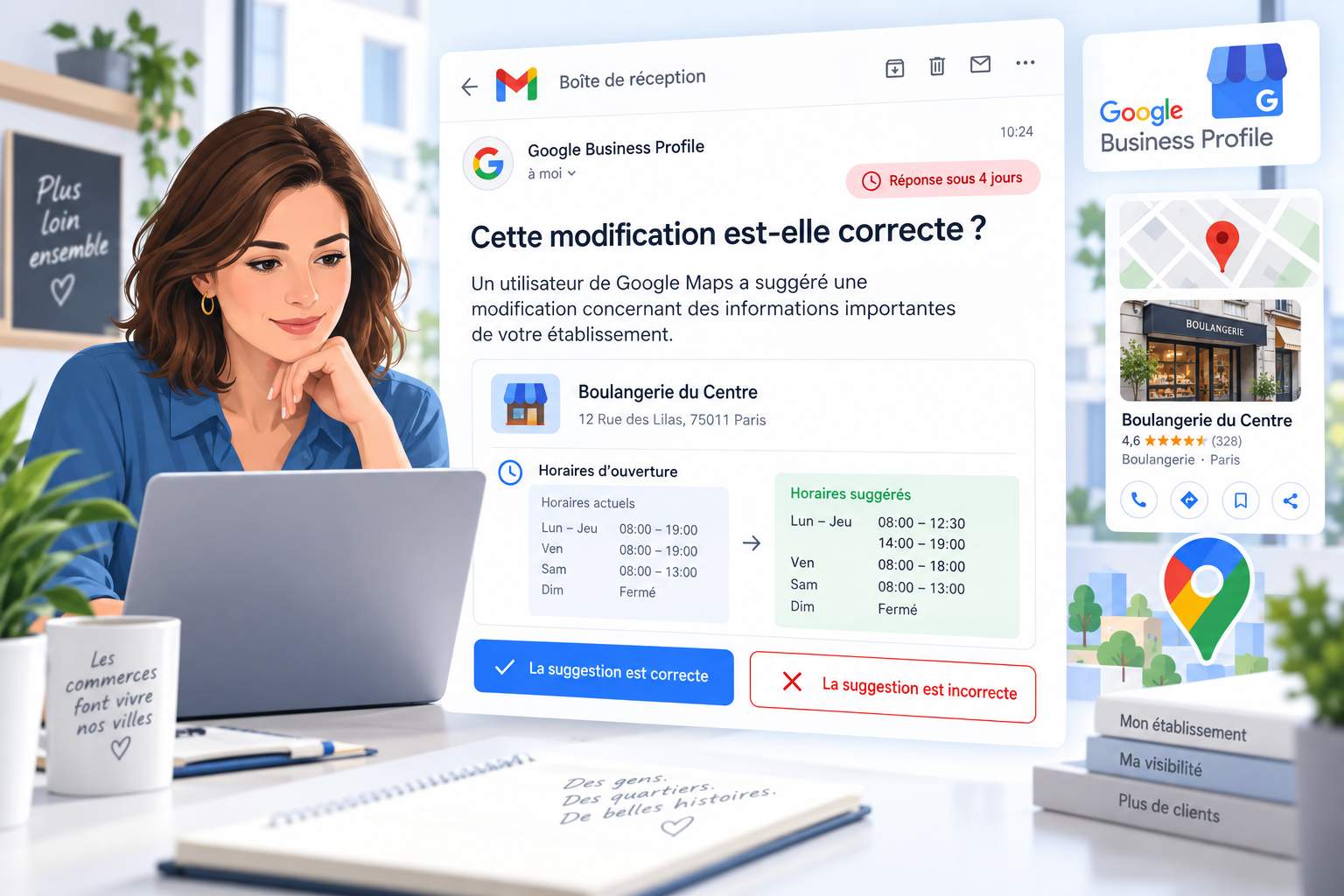
In the official Google Business Profile Help, Google states: responses are reviewed to ensure they comply with content rules, they can be rejected with a request for editing, and the delay is “often up to 10 minutes”, but “sometimes up to 30 days”.
Search Engine Roundtable (author: Barry Schwartz, December 17 2025) relays this clarification and quotes a reading by Hiroko Imai: responses take on a more “official” status, potentially analyzed and exploited by automated systems. The factual point to remember remains the update of the Google doc and the announced deadlines. Search Engine Roundtable
Google also specifies three very concrete details.
The published reply appears as coming from the company, without displaying a personal name.
The customer is notified when you reply.
The customer can modify their review after reading it, and the review date then changes to reflect the latest update.
What this means for your processes
In 2026, a “good” response strategy is as much a question of tone as of compliance and timing.
Example of a “safe” negative response (structure):
Paragraph 1: acknowledgement + apology if necessary, without admitting inadmissibility.
Paragraph 2: request for non-public contact, without exposing private information.
Paragraph 3: factual commitment to improvement.
This format fits well with Google’s recommendations (keep it polite, don’t expose private information, keep it clear).
Appeals and penalties: 2026 = more friction, greater visibility of penalties
On several help pages, Google displays an identical warning: due to a high volume of notification-related calls, processing times are “currently extended”, and Google asks that duplicate calls not be submitted.
On the sanctions side, Google documents possible restrictions in the event of violation of the “Fake Engagement” policy: inability to receive new reviews for a period, temporary depublication of existing reviews, and above all a visible warning that fake reviews have been removed.
These restrictions are part of a wider context of public pressure and commitments against false advice, notably in the UK after the CMA’s intervention, reported by mainstream media (AP, The Verge, The Guardian, January 2025).
Local SEO impact in 2026: “reviews + responses” become a product to be managed
I don’t know whether Google will “weight” reviews more in 2026 than in 2025, because Google doesn’t publish a ranking formula. On the other hand, what you can control with certainty is the business effect.
More potential customers read reviews signed by pseudonyms. So you need to build trust in other ways: consistency of verbatims, accuracy of responses, incident management, and external evidence (site, photos, content, other review platforms).
On the “ranking factors” part, Whitespark states in its post that the volume and recency of reviews emerge as strong factors in their “2026 Local Search Ranking Factors” study. It’s a third-party study, not a Google doc, but it’s a useful market signal to guide your priorities. Whitespark
Action Plan 2026: My 7 concrete projects to implement
Project 1: Update your requests for advice
Add a phrase of reassurance: “You can publish with a nickname and photo if you prefer.” The aim is to increase response rates in sectors where public exposure is holding back. This lever is explicitly recommended by SEO.com and Whitespark. In B2B it used to be more complicated to get reviews than in B2C, but now it’s easier!
Project 2: Standardize a moderation-compatible “response style
Avoid aggressiveness, accusations, disclosure of information, and public “evidence” that exposes personal data. Google reminds you that replies must remain professional and respect its rules. But when the notice is defamatory, you’ll also need to get it changed or deleted… Change? that’s much less likely under speudo.
Job 3: Remove the dependency on the reviewer’s name in your replies
This is the anti-“doxxing” point: your answers must remain valid even if the public name changes tomorrow. Whitespark explains why this scenario is plausible (retroactive effect of names). The worst thing would be if the nominative answer skipped because the profile wanted a speudo retroactively by going back to the notice. The only winners in this story are going to be places where people generally don’t like to be seen (political party headquarters, religious places, adult clubs, etc.).
Task 4: Implement tighter surveillance
SEO.com anticipates more potential abuses (review bombing, competitive attacks) with the perception of anonymity. You don’t control the product, but you do control the speed of detection and internal escalation.
Task 5: Save your notification history
Whitespark recommends regular export of notice data, particularly as the display of identities may change and notices may disappear or be modified.
Project 6: treat appeals and compliance as a pipeline
As appeal times are advertised as being longer, document each case (captures, dates, context) and avoid duplication. This is exactly what Google asks in its help pages.
Task 7: diversify your proofs of trust
I recommend that you don’t rely solely on Google for reviews, not least because of the potential skepticism over waves of “pseudonymous” reviews. In 2026, your reputation must exist on several media and in your own assets (site, customer cases, content). Water several plants to create a beautiful forest!