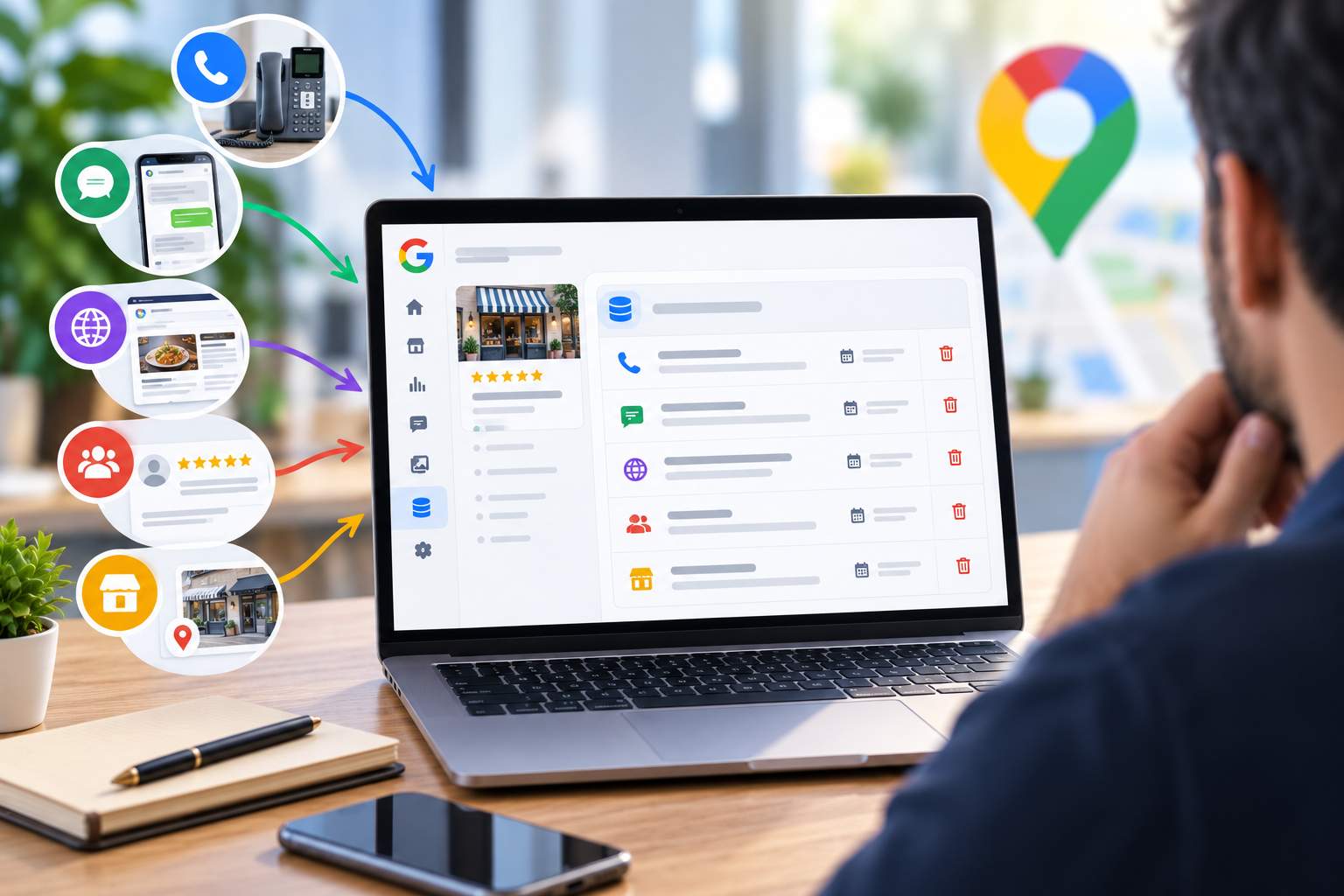
In short: local SEO and GEO are not opposites, they complement each other. The former aims to position a store in Google Maps results and the local pack. The second seeks to get that same store cited by generative AIs like ChatGPT, Perplexity or Google AI Overviews. For a shopkeeper in 2026, ignoring one of these two means letting a competitor snatch up half the potential clientele.
- Local SEO: optimize Google listing, customer reviews and geolocation to appear in Google Maps.
- GEO: optimizing content to be recommended in AI synthetic responses.
- The two disciplines share 80% of their technical foundations (E-E-A-T, schema.org, reliable sources).
- According to Search Engine Land (2025), AI Overviews reduce organic CTR by 15 to 35% on informative queries.
- Retailers who neglect their digital reputation risk having AIs recommend their competitors for them.
Local SEO and GEO: two disciplines, one goal for the merchant
Local SEO aims to make a business listing appear in Google Maps and the local pack. GEO, on the other hand, aims to get the business mentioned in the responses generated by artificial intelligence. For a local retailer in 2026, the difference is measured in lost or gained sales.
Let’s take a concrete example. Marie runs a cheese shop in Bordeaux. For years, her SEO strategy was based on her Google My Business listing, customer reviews and a few geolocalized blog posts. Today, when a tourist asks ChatGPT “where to buy artisan cheese in Bordeaux”, the AI doesn’t consult Google Maps. It synthesizes its own data. If Marie’s cheese shop doesn’t appear in this synthesis, it becomes invisible to a growing proportion of its potential clientele.
Local SEO relies on measurable signals: consistent NAPs (name, address, phone), volume of Google reviews, frequency of published photos, presence in local directories. GEO, on the other hand, values other markers: citations in third-party sources, mentions on Wikipedia and specialized forums, semantic consistency of web content. The latter feeds on, but is not limited to, the former.
Defining local SEO remains an indispensable foundation. Without a well-maintained Google listing and regular customer reviews, no GEO strategy will take off. AIs rely on existing reputation signals to decide which brands to recommend.
Why retailers can no longer limit themselves to local SEO alone
A bakery that invests solely in Google My Business risks missing out on a silent revolution. By 2026, nearly one in three consumers will be using generative AI to prepare a local purchase, according to estimates from audits by specialist firms. If the AI never mentions your brand, you don’t exist in this conversation.
The challenge goes beyond mere visibility. Generative AIs reproduce and amplify existing reputation signals. A business with 4.8 stars and 300 reviews will systematically be preferred to a competitor with 3.9 stars, even if the latter is better positioned geographically. Bad customer experiences are also fed back: a restaurant singled out for disappointing service in several Google reviews can have these criticisms rephrased and presented as fact by the AI.
Local visibility in 2026: what geolocation will really change
Geolocation remains the number-one pillar of local SEO, but its logic is evolving. In classic local SEO, Google cross-references the user’s GPS position with the most relevant business listing. In GEO, AIs also integrate conversational context, stated preferences and exchange history.
A customer asking ChatGPT for “an organic hairdresser near me” triggers a different process to a Google Maps search. The AI is not content with geographical proximity. It looks for a hairdresser whose content, reviews and third-party mentions explicitly evoke an eco-responsible approach. Without this specific vocabulary in your listing, articles or customer reviews, you’re out of the picture.
The winning merchant in 2026 works three levers in parallel: the accuracy of his business listing (main category, attributes, opening hours), the semantic richness of his published content (blog, local pages, FAQ) and the quality of external mentions (local press, sector directories, neighborhood influencers).
Local queries are evolving towards longer conversational formulations. “Best wedding florist Lyon 6” is giving way to “I’m looking for a florist who makes country-style bouquets for a September wedding in Lyon’s sixth arrondissement”. This change calls for a different digital strategy, where every detail counts.
The critical role of reputation in local digital marketing
The average rating of a business, the number of reviews and the frequency of owner responses are the most powerful signals for both disciplines. A BrightLocal study from 2025 indicates that 87% of consumers read online reviews before making a local purchase, and that generative AIs give major weight to these same signals when formulating their recommendations.
A plumber in Le Mans who collects 5 new reviews every month is unknowingly building up his GEO capital. Each review enriches the vocabulary associated with his business, multiplies occurrences of his name in positive contexts, and increases his likelihood of being cited by AIs in responses to queries like “who to call in an emergency for a leak in Le Mans”.
Traditional referencing or AI positioning: how to decide for a local business
For a retailer, the trade-off between local SEO and GEO depends on three factors: current digital maturity, business sector and catchment area. A new store with no reviews or optimized listings should prioritize local SEO. An established brand with a solid reputation can quickly add GEO optimizations.
Here’s a table comparing the two approaches to help you decide where to focus your efforts.
| Criteria | Local SEO | GEO |
|---|---|---|
| Main objective | Appear in Google Maps and the local pack | Being quoted in the answers to generative AIs |
| Priority signal | Complete Google file, customer reviews, NAP | Third-party sources, semantic consistency, E-E-A-T |
| Result format | Clickable link to file or site | Textual mention in a synthetic response |
| Time to results | 2 to 6 months | 3 to 9 months depending on domain authority |
| Performance measurement | Local pack position, clicks, calls, routes | Manual appearances in AI responses |
| Initial investment | Low to moderate | Moderate, but builds on existing SEO |
| Main risk | False advice, file suspension | Mention of bad experiences amplified |
The pragmatic retailer starts by auditing his current digital presence. How many reviews? What rating? How often are they published? What competitors appear when you ask ChatGPT about your sector in your town? These questions structure the roadmap. Detailed analyses like the one proposed in this summary on the concrete differences between GEO and SEO provide useful evaluation grids.
Priorities according to merchant profile
For a new business that has been open for less than 18 months, the absolute priority remains the consolidation of local SEO: complete Google listing, quality photos, active collection of reviews, presence in 5 to 10 industry directories. Without these foundations, no AI will recommend the establishment.
For an established business with a rating above 4.5 and more than 100 reviews, GEO investment becomes a priority. Creating content that answers customers’ concrete questions, publications on third-party platforms, partnerships with local media. Returns on investment can be measured over 6 to 12 months, but the lead gained over unprepared competitors is considerable.
Customer reviews and e-reputation: the common fuel of local SEO and GEO
Customer reviews are the most powerful lever for both disciplines, without exception. A business with a Google rating of 4.7 and 250 reviews will systematically be preferred, by both Google and AI, to a competitor with a rating of 3.8 and 40 reviews. This mechanism transforms every satisfied customer into an invisible but decisive ambassador.
Sophie runs a yoga school in Nantes. In 2024, she had 32 Google reviews. By implementing a simple protocol – sending an SMS after each trial class with a direct link to the listing – she reached 187 reviews in 14 months. As a result, her listing now appears at the top of the local pack for “yoga Nantes center”. And when a user asks Perplexity “where to learn yoga in Nantes if you’re a beginner”, her school is one of three recommendations.
This synergy is no accident. Generative AIs are trained on corpora that include Google reviews, forums and blogs. The more your name appears in positive contexts, the greater the probability of being mentioned by an AI. Conversely, a business that collects negative reviews sees its problems amplified. ChatGPT may well explain to a user that “this restaurant had several service quality reviews in 2025” by synthesizing dozens of individual reviews.
Proactive digital reputation management via Reputational SEO is becoming an integral part of any digital marketing strategy in 2026. Responding to every review, reporting false comments, dealing with offline dissatisfaction before it pollutes the web: these basic reflexes produce cumulative effects over years.
When AIs become judge and jury of your reputation
A risk underestimated by many retailers: AIs reformulate criticisms by presenting them as objective facts. An isolated review that denounces “excessive waiting times” can be taken up by ChatGPT as “this restaurant is known for its waiting times”. This linguistic transformation changes everything. An individual testimonial becomes a characteristic attributed to the establishment.
The solution is to produce enough positive, factual content to balance the scales. Blog articles, structured customer testimonials, press mentions, YouTube videos. The more the business feeds the web with verifiable positive signals, the more material AIs will have to formulate favorable recommendations. The approaches detailed in this SEO and GEO integration guide offer methodologies that can be applied to independent businesses.
Hybrid digital strategy: how to combine local SEO and GEO without blowing your budget
An independent retailer doesn’t have the time or budget of a large retailer. However, an effective hybrid strategy is based on five concrete actions, achievable with a reasonable investment and a little discipline.
- Lock the Google listing: precise main category, filled-in attributes, up-to-date schedules, 20 photos minimum, description rich in sector and geographic keywords.
- Automate review collection: QR code at checkout, post-purchase SMS, thank-you e-mail with direct link. Target: 5 to 10 new reviews per month.
- Publish useful local content: one article a month that answers a concrete customer question (e.g. “how to choose a cheese for a raclette for 8 people”). This content feeds local SEO and GEO simultaneously.
- Multiply third-party mentions: local press, neighborhood blogs, partnerships with other businesses, participation in events relayed online. Every mention reinforces credibility in the eyes of AIs.
- Technical page structuring: schema.org LocalBusiness, FAQPage, review markup, structured product or service data. A tool like the LocalBusiness schema generator can produce this code in just a few minutes.
This roadmap requires around 4 to 6 hours per month for an independent business. The investment is derisory compared to the returns obtained over 12 to 24 months. And above all, it builds a lasting asset: the digital reputation acquired remains valid even if the algorithms change.
Classic pitfalls to avoid in a hybrid strategy
First trap: buying fake reviews. AIs now detect artificial patterns and penalize the businesses concerned. Worse still, Google can suspend the listing, wiping out months of local SEO work overnight.
Second pitfall: producing generic copy-and-paste content. Generative AI favors sources that provide a unique perspective. Repeating a competitor’s arguments without added value guarantees invisibility in recommendations.
Third pitfall: neglecting customer questions. A retailer who doesn’t listen to feedback from the field produces content that is disconnected from the real questions asked by its target audience. Conversely, retailers who turn every recurring question into an article or FAQ feed a virtuous circle: the more they answer real questions, the more AIs identify them as reliable sources.
Local SEO in 2026 on Google Maps and AI search rewards those who take a patient and consistent approach. Shortcuts rarely pay off. Merchants who think long-term and invest in the real quality of their customer experience build an advantage that neither algorithms nor harried competitors can easily take away.