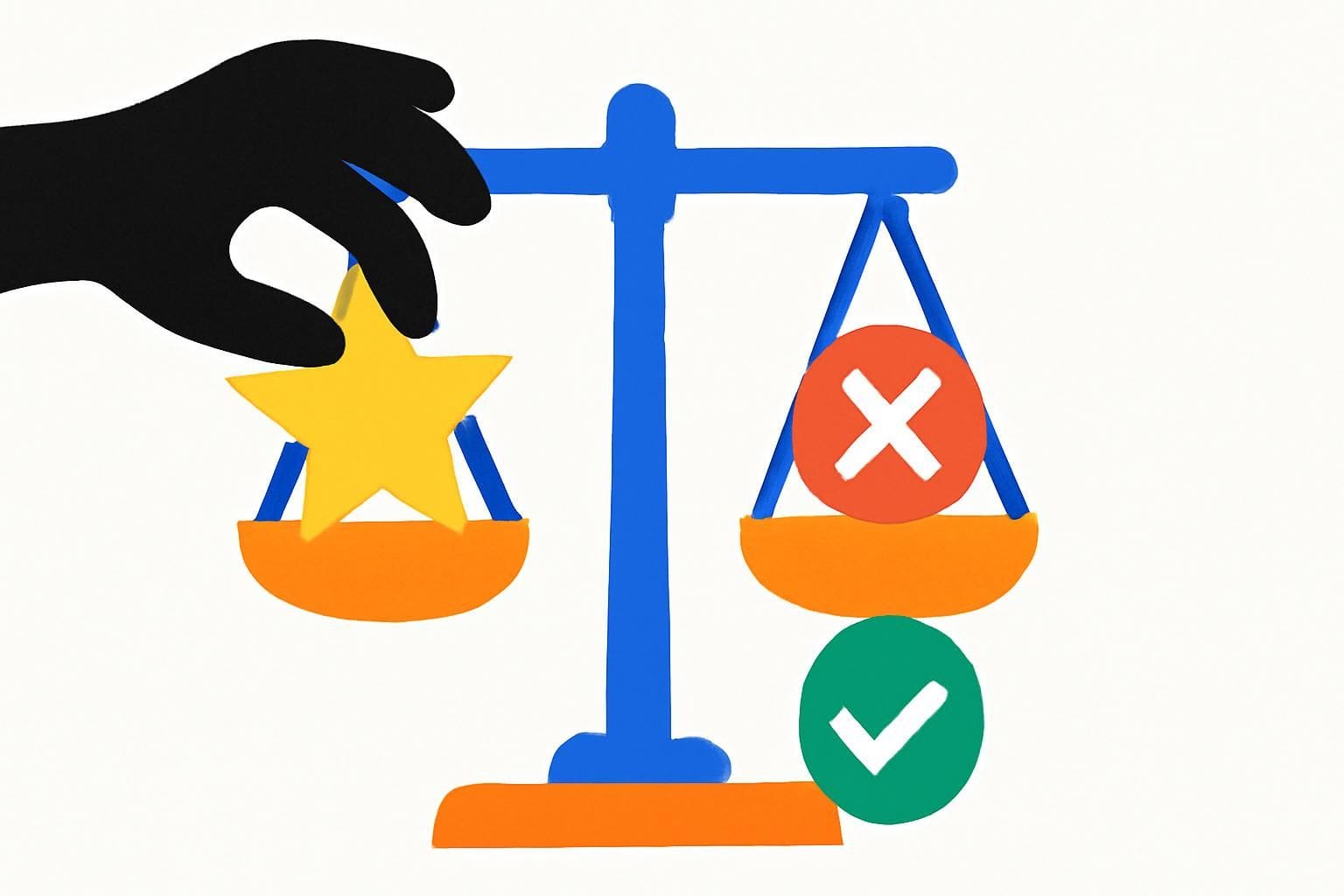
In short: one star less on your Google listing can cut your sales by between 9% and 22%, depending on the sector, according to the work of Michael Luca (Harvard Business School, 2016). In a world where generative AIs now recommend businesses based on their online reputation, the average score becomes a measurable financial asset. Here’s what you need to understand, and above all, how to react before your competitors steal your market share.
- A drop of 1 star = up to 22% in lost sales (Harvard study on Yelp)
- 88% of consumers consult Google reviews before making a local purchase (BrightLocal 2024)
- Conversational AIs prefer files above 4.5 stars
- An unaddressed negative review costs an average of 30 potential customers
- Customer acquisition costs increase by 40% for a score below 4.0
The true cost of a lost star on your Google listing
One less star on Google means between 9 and 22% less sales. The figure comes from a now-classic study by Michael Luca at Harvard Business School, since confirmed by several industry analyses. In concrete terms, a restaurant that is downgraded from 4.5 to 3.5 stars will see its patronage plummet in the weeks that follow, without anything else having changed in its offering.
Take Marc, a restaurateur in Bordeaux. His table proudly boasted 4.6 stars with 280 reviews. Three mismanaged bad experiences and two vengeful reviews later, his rating slipped to 4.1. The result over six months: 18% fewer covers at lunchtime, 12% fewer on evening service. That’s around 47,000 euros less gross margin, not counting the time spent trying to respond in a hurry.
The mechanism is simple to understand. When an Internet user searches for “pizzeria + town”, Google’s local algorithm first displays the best-rated listings in the Local Pack. Going below the psychological threshold of 4 stars means leaving the field of vision of the majority of prospects. Consumers’ eyes scan the ratings before they even read the name of the establishment.
Why the 4.2-star threshold changes everything
BrightLocal measured in its 2024 annual report that 76% of consumers won’t even consider a business with less than 4 stars. The critical threshold is around 4.2: below this level, click-through rates plummet by over 50%. Above 4.5, conversions explode.
This psychological mechanism has a name in the jargon: the halo effect. A good rating not only reflects past quality, it also conditions future perception. A customer who sees 4.7 is already convinced. The same customer faced with 3.8 will look for the slightest flaw to confirm his negative intuition.

Calculate the exact financial loss due to negative reviews
To calculate the precise impact, you need to cross-reference three variables: your current rating, your average shopping basket and the volume of monthly leads generated by Google. The most reliable method is to compare the conversion rate of your listing before and after a drop in rating. Many merchants are shocked to discover that the monthly loss exceeds the cost of a real review management strategy.
Let’s imagine a bakery in Lyon with a 4.5-star rating, 8,000 monthly page views and an average shopping basket of 12 euros. If the form-to-visit conversion rate drops from 11% to 7% following a downgrade to 3.9 stars, 320 customers per month are lost. That’s a monthly loss of 3,840 euros. Over the year, the bill rises to over 46,000 euros.
| Google rating | Average click-through rate | Estimated change in sales |
|---|---|---|
| 4,8 – 5,0 | 32% | +18% |
| 4,5 – 4,7 | 24% | Reference |
| 4,0 – 4,4 | 15% | -12% |
| 3,5 – 3,9 | 8% | -22% |
| Less than 3.5 | 3% | -38% |
A sector-specific opinion calculator provides a personalized estimate based on your activity. The tool takes into account the volume of prospects, local competition and the psychological threshold specific to each business. A hairdresser does not suffer the same elasticity as a garage mechanic when faced with a poor rating.
The domino effect on acquisition costs
When your rating drops, the cost of customer acquisition rises automatically. You then have to compensate with Google Ads, aggressive promotions or Meta campaigns. The hidden costs of a poor reputation include this advertising surcharge, which often exceeds the direct loss of sales.
How generative AI is reshuffling the cards in online rating
Conversational AIs such as ChatGPT, Perplexity or Gemini now recommend local businesses based largely on aggregated reputation. When a user asks for “the best plumber in Toulouse”, the AI picks out the listings with the highest ratings and most favorable customer sentiment. Average businesses become invisible, no matter how long they’ve been around.
This phenomenon is called GEO, Generative Engine Optimization. It’s the natural evolution of local SEO in the age of artificial intelligence. Brands with a solid score see their visibility multiplied, while those with negative feedback are cited as counterexamples. Worse still, some AIs explicitly mention recurring reasons for dissatisfaction drawn from text reviews.
The invisible mechanics of online sentiment
Algorithms are no longer content with average scores. They analyze online sentiment via automatic language processing. A business with 4.3 stars whose reviews frequently mention “unpleasant staff” or “slow service” will be downgraded compared to a competitor with 4.2 whose feedback mentions “warm welcome”.
Camille, an interior designer in Nantes, learned this the hard way. Her listing had 4.4 stars, but three disappointed customers had written the word “delay” in their comments. When a prospect asked ChatGPT for a recommendation for an architect in Nantes, his name came back with the phrase “attention to delays reported by certain customers”. Appointments became rare. A targeted reputational SEO strategy reversed the trend within four months.
Why top-rated competitors eat into your market share
The logic is implacable: for an equivalent offer, the best-rated business captures the majority of prospects. This capture is cumulative, as each new satisfied customer feeds the score, which attracts new customers. The delay becomes exponential. The players who understood this dynamic in 2023 have widened a gap that is sometimes irrecoverable today.
Concrete ways to protect your Google rating
Protecting your customer review rating rests on three pillars: actively collecting positive feedback, dealing with each negative review within 24 hours, and monitoring competitor reviews for manipulation. Without these regular actions, deterioration is inevitable, as dissatisfied customers express themselves five times more spontaneously than satisfied customers, according to Trustpilot data.
Proactive feedback changes everything. A satisfied customer who is politely asked for feedback leaves a comment in 30 to 40% of cases, compared with 5% spontaneously. Multiplying the benevolent solicitations after each successful transaction creates a safety cushion against the inevitable disappointments. This is the principle of reputational push applied to everyday commercial life.
Respond to negative reviews without getting bogged down
A well-written public response to a negative review transforms the comment into proof of professionalism. Prospects read the manager’s responses: 89% according to BrightLocal say that the quality of responses influences their decision. A dry or defensive retort compounds the damage, while an empathetic, factual response neutralizes the attack.
Beware of extortion scams, which are on the increase. Some individuals post a false negative review and then contact the manager to offer to withdraw it in return for payment. Learning how to detect these scammers who steal your reputation is part of basic digital hygiene for any merchant.
Monitor, measure, adjust
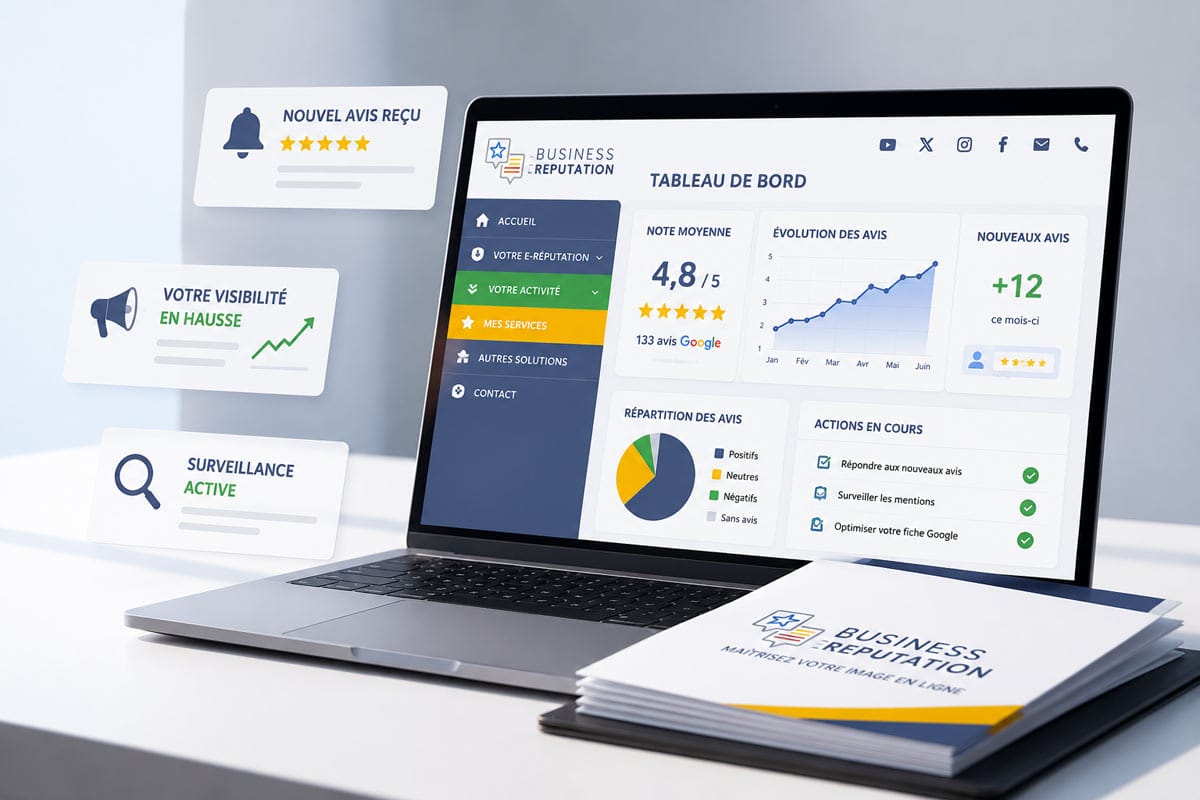
Online perception changes every week. A simple dashboard tracking average rating, monthly review volume and sentiment distribution is all that’s needed to steer. Retailers who check their reviews less than once a month discover problems too late. Those who check every week react in good time.
The Ministry of the Economy has issued several alerts on these subjects, as this official article on reviews and reputation reminds us. The legal framework is getting tougher, as are transparency obligations. Taking advantage of this context to structure your approach will give you a head start while your competitors suffer.
Transforming reputation into sustainable competitive advantage
By 2026, online reputation will be the leading intangible marketing asset for local businesses, ahead of local advertising and flyers. Brands that invest in a genuine e-reputation approach capture a disproportionate share of local leads, as they combine Google visibility, AI recommendations and digital word-of-mouth. This leverage effect is measurable and reproducible.
Sophie runs a small renovation business in the Var region of France. For two years, she neglected her Google listing, believing that her customers came mainly by recommendation. When her rating dropped from 4.1 to 3.7 following two complicated jobs, her phone stopped ringing. Six months of methodical work on collecting reviews and public responses brought it back up to 4.6. Its order book now shows three months of visibility.
The specific challenge of regulated professions
Some professions are under particular pressure. Thee-reputation of architects is a perfect illustration of this complexity: a single detailed negative opinion can block several private tenders. The same is true of lawyers, doctors and accountants. For these professions, each review carries three to five times more weight than in the restaurant business.
Anticipating developments in the coming year
Platforms are tightening their anti-fraud algorithms, Wikipedia is reviewing its policy on company pages, and AIs are integrating new trust signals. Understanding why everything is changing in 2026 for Wikipedia and personal branding will help you align your strategy with the new rules of the game. Businesses that anticipate these shifts take up positions that are difficult to regain.
The bottom line is clear: ignoring your Google score is like letting your competitors write your own commercial epitaph. Numbers don’t lie, and algorithms even less so. Every star counts, every review weighs, and every month without a strategy widens the gap with those who have understood the rule. The good news is that it’s still possible to regain control, provided you stop treating your Google listing as an administrative detail.