Managing your online reputation without an agency or SaaS software has become accessible to any motivated merchant. According to a BrightLocal 2024 study, 87% of consumers read Google reviews before visiting a local business, and a well-maintained listing can generate up to 35% more clicks. The promise of this article is to show you, step by step, how to regain control of your digital image with Google’s free tools and a little method. You don’t need a 200-euro monthly subscription to manage your e-reputation. Just rigor, time well invested, and a few reflexes that pros use every day.
In short: autonomous management of your Google Business Profile remains the most profitable lever for a local business. Here are the points to remember before diving into the details.
- Self-management of your Google listing is free and accessible to anyone with a smartphone.
- Free monitoring via Google Alerts covers 80% of the needs of a local SME.
- Customer reviews now carry as much weight as traditional SEO when it comes to appearing in the Local Pack.
- Generative AIs give priority to brands with a rating of over 4.3 stars.
- One cold response to a negative review is better than ten advertising campaigns.
Why managing your Google reputation yourself is a game-changer for 2026
Taking back control of your online reputation without an intermediary is above all a question of sovereignty. You know your customers better than any Parisian agency charging 1,500 euros a month. And with the massive arrival of generative AIs in purchasing paths, direct control is becoming a decisive competitive advantage.
The year 2026 marks a clear turning point. Conversational assistants such as ChatGPT, Perplexity or Gemini draw their recommendations from Google Business Profile structured data and verified reviews. A bakery in Toulouse with 4.7 stars and 280 reviews will be systematically cited by an AI when a user asks for “the best bakery near me”. Its competitor with 3.9 stars? Invisible. Disappeared from the algorithmic radar.
The hidden cost of total delegation
Many retailers entrust their listing to an agency, only to discover six months later that they have lost their main administrator access. A butcher in Lille recently testified to a classic situation: his service provider had migrated his rights, and the breach of contract deprived him of his own listing for three weeks. Three weeks without being able to respond to notices, without being able to change his summer hours. A catastrophe in the middle of August.
Self-management protects you from this kind of dependency. You keep control, you decide the tempo, and above all you save between 1,800 and 6,000 euros a year, depending on the SaaS formulas on the market.
What AIs really look at to recommend you
Language models analyze three main signals. First, the consistency of your NAP data (name, address, phone number) across the web. Secondly, the freshness of publications on your listing, including photos. And finally, the overall sentiment of your reviews over the last twelve months. A business that neglects its listing for six months sends out the signal that its activity is dormant or even closed. Google’s Knowledge Graph captures these signals and redistributes them to partner AIs.
Optimize your Google Business Profile without spending a penny
SEO optimization of your Google Business Profile listing is based on free fundamentals that 70% of businesses still neglect. A precise main category, a description rich in local keywords, weekly photos, detailed attributes: these are the building blocks that will move your business up the local pack without spending a cent on advertising.
The Google listing is still the only free medium where you can speak directly to a buyer intending to buy. When someone types in “florist open now Marseille”, they want to buy within ten minutes. Not in ten days. This warm intention is worth its weight in gold, and can only be captured with an optimized listing.
The main category, that detail that makes all the difference
Choosing “Restaurant” when you’re an “Italian Restaurant” means you lose 40% visibility on specialized queries. Google now offers almost 4000 categories. Dive into the list, compare with your three top-ranked competitors, and align yourself with the most precise formulation. An event caterer is not a generic catering service. This precision counts enormously for local SEO, as the guide dedicated to caterers on Business E-reputation explains so well.
Photos, an under-exploited lever
An internal Google study revealed that listings with more than 100 photos received 520% more calls than listings with fewer than 10 photos. Add two to three photos per week. Vary the angles: facade, interior, products, team, backstage. An optician in Nantes doubled his traffic in six months simply by publishing three photos taken with his phone every Friday.
Comparative table of free versus SaaS levers
| Lever | Free solution | Paid SaaS solution | Real efficiency |
|---|---|---|---|
| Notice follow-up | Google + email notifications | Central Dashboard €89/month | Identical for 1 plant |
| Response to notices | Manual, customized | Generative AI + templates | More engaging human |
| Web monitoring | Free Google Alerts | Monitoring tool €150/month | Free is enough for SMEs |
| Gathering opinions | Short link + in-house QR code | Automated platform | The manual converts better |
Collect authentic customer reviews without costly automation
Collectingcustomer reviews on your own is based on three pillars: a short, memorable link, a QR code printed everywhere, and a request at the right moment in the customer journey. A satisfied customer solicited within 24 hours of a visit converts five times better than an e-mail sent a week later. Timing makes all the difference.
Google offers a free shortcut link dedicated to each establishment from the “Ask for reviews” tab of the dashboard. You can stick this link in your email signatures, on your receipts or in your post-sale WhatsApp messages. A hairdresser in Bordeaux increased his reviews sevenfold simply by sticking a QR code on the mirror opposite the shampoo seat. While rinsing, the customer scans. Genius of simplicity.
The art of perfect timing
Asking for feedback right after the bill in a restaurant works less well than a text message sent the next morning. Why is this? Because the customer has digested the experience, told friends and family about it, and has the mental time to write three lines. Restaurateurs who apply this simple rule achieve conversion rates of 18 to 25%, compared with 4% for those who ask point-blank.
Avoid regulatory pitfalls
Offering a discount against a positive review violates Google’s terms of use and exposes you to massive deletion of your history. Workshopsanalyzing defensive strategies against cyberextortion by false reviews show that artificially “boosted” listings fall within six to twelve months. It’s better to have 80 genuine reviews than 300 suspicious ones that evaporate overnight.
Solicitation channels that really work
- Post-sales SMS: 98% open rate, 12-20% conversion.
- Email with direct link: 6-10% conversion, ideal for B2B services.
- QR code at the checkout: excellent for restaurants and retail outlets.
- Oral request at the end of the performance: the most effective, but requires courage.
- Thank-you card slipped into the bag: a personal touch that works in the store.
Monitor your e-reputation with free tools
Free monitoring of your e-reputation consists of three tools accessible to all: Google Alerts for mentions, the Google Business Profile dashboard for reviews, and a weekly manual search of your business name. This 20-minute-a-week routine covers virtually all the risks for a single-business operation.
Setting up Google Alerts takes just three minutes. You enter your company name, the name of the manager, and any common spelling variants. Each new mention arrives in your inbox. Thanks to this system, a Strasbourg plumber discovered that a disgruntled former customer had published a long post on a local forum. Detection within 48 hours, a reasoned response published, situation defused. Without the alert, he would have discovered the paving stone six months later.
Manual watch, a forgotten reflex
Type your business name into Google once a week, in private browsing, from a different phone. You’ll see exactly what your prospects see. This simple manipulation will reveal astonishing things: duplicate listings, old addresses lying around, mentions in obscure directories. Regular web monitoring of e-reputation remains the fundamental hygiene measure that too many retailers forget.
Detecting duplicate files and usurpations
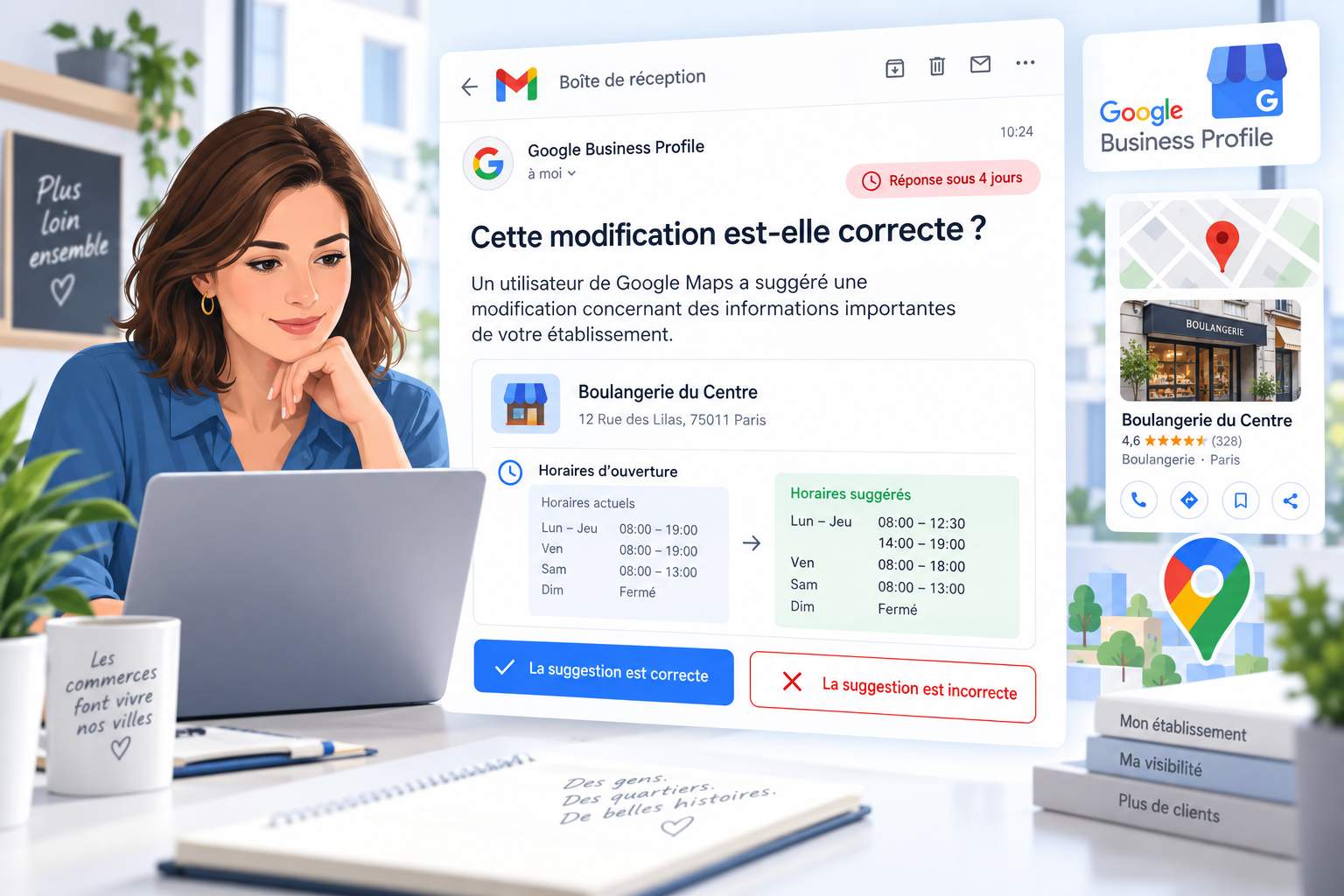
A worrying phenomenon is on the rise: the creation of fake Google listings by competitors or scammers. These listings hijack your calls and unknowingly damage your reputation. Spot them manually: search for your business in your city, check for duplicates, and report them immediately using the dedicated form. The guide to copied Google My Business listings details the complete procedure.
Responding to negative reviews without an agency: the method that works
Responding to a negative review without an agency requires three things: composure, a proven framework and a response time of less than 48 hours. The golden rule can be summed up in one sentence: you respond to the author, but you’re writing for the 200 prospects who will read that response in the next six months.
A well-handled one-star review generates more trust than an avalanche of perfect five-star reviews. Consumers no longer believe in listings without any negative feedback. According to a Trustpilot survey, 62% of buyers specifically check for negative reviews and how the company responds to them before making their decision.
The four-stage response structure
First give thanks for the feedback, even if it’s negative. Then acknowledge the frustration without necessarily admitting fault. Suggest a concrete solution or direct contact. End with a cordial opening. This structure avoids both a defensive tone and excessive complacency. A pastry chef in Lyon turned a two-star review into a loyal customer simply by offering to remake the birthday cake at her own expense. The customer not only changed his rating, but came back three times.
Pitfalls to avoid
Never publicly dispute the facts, even when the customer is lying. You won’t convince the author, and you’ll give readers the image of an aggressive merchant. Also, avoid offering explicit compensation in public, which attracts freeloaders. Best practice in dealing with negative reviews emphasizes the need to switch quickly to a private conversation.
When to signal rather than respond
Some reviews deserve to be reported to Google rather than responded to. Clearly false reviews, personal attacks, mentions of competitors, defamatory content: these are all grounds for requesting removal via the official form. The success rate is around 30% for well-argued reports. The correlation between a lost star and sales makes this work profitable for even the most modest of businesses.
Building a sustainable strategy to stay visible in the face of AI
Anticipating the Google management of the next few years means understanding a profound mutation: recommendations are gradually shifting from traditional search engines to AI assistants. A brand absent from ChatGPT or Gemini conversations in 2027 will be invisible to 40% of buyers under 35 years, according to Gartner projections.
This shift requires us to rethink content production. AIs rely on verifiable third-party sources: local press, industry blogs, specialized directories, quotes in podcasts or articles. Multiplying consistent mentions of your brand on the web builds what experts call “distributed topical authority”. This is precisely what makes an AI cite your bakery rather than the one next door.
Content that feeds AIs
Post regularly on your Google listing: news, events, new products, behind-the-scenes. These posts are indexed and feed the Knowledge Graph. Keep your blog simple, even with two posts a month. A baker who talks about his organic flour, his wood-fired bakery, his partnerships with a local miller creates content that gets referenced and quoted. Recent analyses of Google reputation management confirm that active listings outperform dormant listings by 200% to 300%.
Measuring what really matters
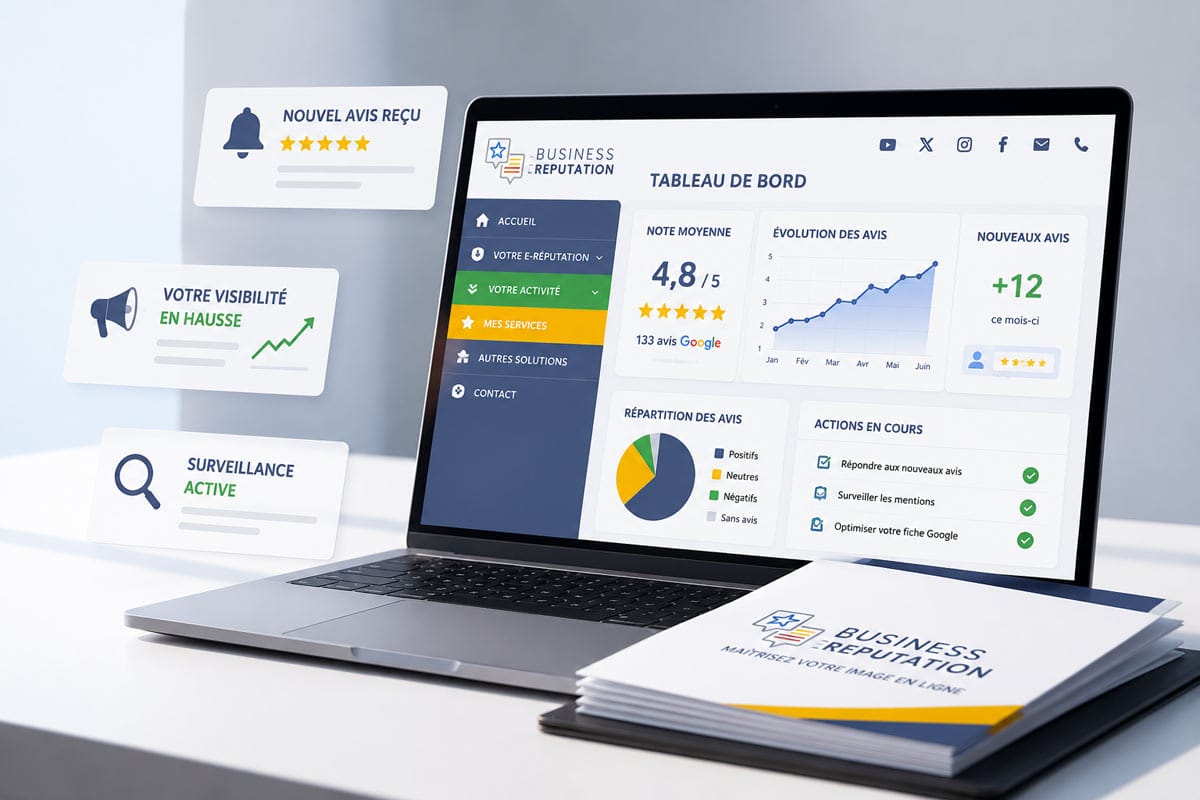
Three indicators are all you need to steer your business in the right direction. The number of new reviews per month, which should increase by 5 to 10% per quarter. Average rating over the last 90 days, ideally above 4.3. Response rate, which should reach 100%. With this minimalist dashboard, you’ll know exactly where you stand without having to pay for a 200-euro monthly tool. The free review calculator also lets you simulate how many positive reviews are needed to erase the impact of a negative review.
Preparing for the arrival of new platforms
Other players are emerging alongside Google. Trustpilot is gaining ground in e-commerce, Yelp remains influential in certain cities, and new sector-specific directories are appearing every year. Don’t put all your eggs in one basket. Reserve your business name for the three or four main platforms in your sector, even if you don’t actively promote them. This preventive occupation prevents future usurpations and diversifies your trust signals for AIs.
The bottom line: independent management of your e-reputation is not only possible, but often more effective than costly delegation. Invest 30 minutes a week, follow the method, and watch your results climb over six to nine months.