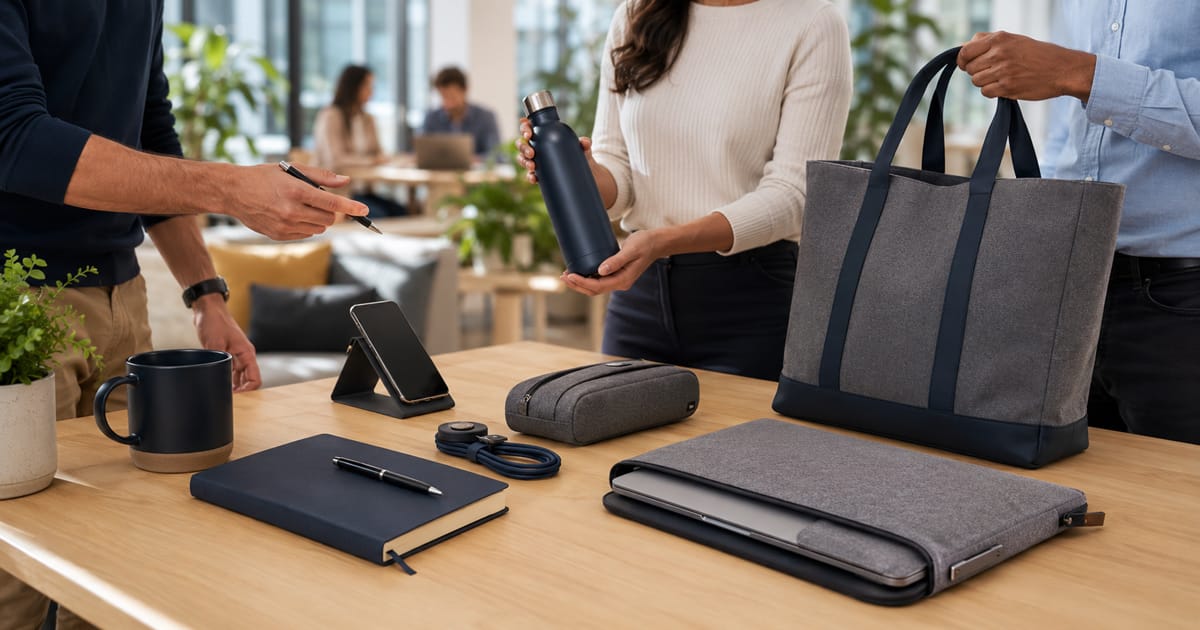
In many companies, internal promotional items pile up: mugs gathering dust at the back of a closet, pens that don’t write, and tote bags too fragile to use. However, when chosen wisely, promotional items for your employees can truly improve their daily lives, strengthen their sense of belonging, and convey your company’s values. The challenge is to move from a “nice but useless gift” to an item that people keep, use, and that serves as a positive reminder of the company.
Over time, this iterative process allows you to build a collection of internal items that truly reflect your culture and the needs of your teams. By taking the time to define your needs and carefully selecting your promotional items for your employees, you can strike the right balance between practicality, quality, brand image, and budget. The ultimate goal remains the same: items that become part of employees’ daily lives, rather than gifts that gather dust.
4 Questions to Ask Yourself Before Making a Choice
Before selecting an item, asking yourself a few simple questions can help you filter out many appealing but irrelevant ideas. The first question concerns the context: when will it be used? At the office, while working remotely, on the go, or during internal events? A desk accessory won’t meet the same needs as an item designed for mobility or the home office. Clarifying the primary use helps guide your choice from the start.
The second question is: What specific problem does it help solve? Workspace organization, comfort, hydration, cable and tech management, transporting equipment… A good in-house product addresses a small but real pain point experienced by the teams. Third, consider durability: will it last more than a year? The quality of the materials, sturdiness, and the ability to recharge or replace a component (for example, on a tech accessory) are key factors. Finally, verifying that it aligns with your values (CSR, innovation, sustainability, local roots) helps avoid discrepancies between your messaging and reality.
5 categories of items that really work well internally
First category: office supplies. A high-quality notebook and pen, a comfortable mouse pad, and a clever or modular pencil holder are always safe bets. They fit naturally into the workspace, are visible both in person and during video calls, and bring the brand closer to moments of collaboration. The key is to prioritize writing quality, comfort, and understated design rather than overloading items with logos.
Second category: comfort and well-being. A reusable water bottle or mug, a small plant, a footrest, or a chair cushion can all contribute to quality of life at work. These items send a clear message: the company cares about day-to-day comfort, not just results. They are particularly relevant in workplace well-being (QVT) or corporate social responsibility (CSR) initiatives, especially when they are part of a broader policy (break areas, ergonomics, reducing single-use items).
Third category: useful tech accessories. A multi-port cable compatible with the provided equipment, a smartphone stand to keep the screen at eye level, a mouse pad with a charging pad, or a small USB hub can resolve recurring annoyances, especially in hybrid work settings. These are items that blend seamlessly into the workflow, subtly reinforcing the brand without being intrusive. Here again, reliability and compatibility take precedence over gimmicky features.
Fourth category:organization and mobility. Sturdy tote bags, pencil cases, laptop sleeves, and lightweight messenger bags make it easier to carry documents, equipment, or personal items. With the rise of flexible office arrangements and remote work, these types of items are becoming increasingly important: they facilitate the back-and-forth between the office, home, and third places. A reinforced tote bag or a well-designed sleeve will see far more use than a flimsy bag chosen solely for its price.
Fifth category: recognition items and events. For internal challenges, rewards, or special occasions (company anniversary, project milestone), a slightly more premium item makes sense: high-quality apparel, a designer accessory, or a limited edition item. The idea is to mark a special moment, not to distribute these items en masse. In this case, the quantity is limited, but the symbolic value is strong—especially if the item is presented in an explicit context of recognition.
3 Mistakes to Avoid
The first mistake is to base your choice solely on price. A very inexpensive item that isn’t very durable will quickly be thrown away or forgotten, which amounts to spending money without making an impact. It’s better to spend a little more on an item that will actually be used, which conveys a sense of professionalism and attention to detail. The second mistake is copying client giveaways without considering whether internal needs are the same: an item that’s relevant at a trade show isn’t necessarily useful for teams in their day-to-day work.
Third common mistake: forgetting to ask employees for their input. A quick survey, a question in an internal newsletter, or a test with a small group can help gauge genuine interest in a particular item before placing a bulk order. This also sends a positive signal of collaborative decision-making: teams see that their input is taken into account in decisions that directly affect them.
What’s next? Determine whether the object was actually useful
Once the items have been distributed, it’s helpful to check whether they’re fulfilling their purpose. A simple initial indicator is to observe: are these items still visible on desks, in meetings, or during video calls three or six months later? If they’ve disappeared from view, it’s likely that they weren’t all that useful. A second approach is to ask a few questions when placing a future order: Which items are used most often? Which ones have been adopted only a little or not at all? What would you prefer instead?