In brief
- Augmented reality applied to local businesses displays a business’s rating, customer reviews, and hours of operation directly above its storefront via a smartphone screen.
- Shopify reports a 94% increase in the average conversion rate observed on AR-enhanced product listings: the same reassurance mechanism now applies to local reputation.
- Google Lens, Live View on Maps, and the first consumer-grade smart glasses rely on three building blocks that are already in use: geolocation, visual recognition, and a database of verified reviews.
- A rating floating above a storefront makes the transparency of reviews physically unavoidable. The sidewalk becomes a results page.
- Businesses without a structured business listing risk becoming completely invisible: no digital layer overlays an empty profile.
Augmented Reality and Customer Reviews: What a Passersby Really Sees When They Point Their Phone
Pointing your smartphone at a storefront and seeing a rating out of five, three recent reviews, and the estimated wait time appear: the technology already exists. Google Lens identifies a restaurant based on its facade, Maps has offered its Live View feature in augmented reality since 2019, and business listings feed these layers in real time. Passersby no longer open a search app—they just look at the street.
Take Camille, for example, the manager of a brasserie on Rue Sainte-Catherine in Bordeaux. A group of tourists stops in front of her patio, pulls out a phone, and sees the following information displayed on the screen: 4.1 stars, 312 reviews, with the latest comment reading, “Slow service on Saturday nights.” Thirty meters away, the competitor boasts a 4.7-star rating, with the manager responding to every negative review. The group walks away. No one stepped inside; no one asked for the menu. The decision was made based on a overlay of pixels above an awning.
This shift deserves to be properly named. Until now, the business’s poor reputation remained hidden: you had to actively search for it on Google Maps to find its reviews. Augmented reality eliminates this deliberate step. The information follows the consumer into the physical world, without any effort on their part.
Studies on the subject are consistent: according to data published by Meltwater in its overview of AR usage, consumer adoption of these immersive interfaces has crossed the critical threshold, driven by the widespread deployment of LiDAR sensors in high-end smartphones. Hardware is no longer the limiting factor. The quality of the displayed data, however, is.
Three display formats currently coexist in tests conducted by major platforms:
- Simple overlays: rating, number of reviews, open/closed status, anchored to the detected storefront.
- Contextual layer: popular dishes, recent customer photos, real-time foot traffic—triggered when the pedestrian slows down.
- Side-by-side comparison: multiple businesses on the same street rated simultaneously within the field of view, ranked by score.
The third format is a legitimate cause for concern among retailers. Seeing one’s rating displayed next to a neighbor’s—in real time—on the sidewalk turns a shopping street into a permanent runway. The analogy with a supermarket aisle is obvious: the highest-rated product catches the eye.
One technical detail determines everything else: for a digital layer to be linked to a business, that business must be properly listed in the database. A listing without a correctly specified primary category remains a gray dot on the map, invisible to the naked eye. AR doesn’t create a reputation—it reveals the one that already exists.
Geolocation, Google Business Profile, and the AR layer: the building blocks that hold the system together
Three technologies work together to display a review above a storefront: high-precision geolocation (GPS enhanced by Wi-Fi data and Google’s visual VPS), image recognition that identifies the storefront, and the review database linked to the business listing. Remove one of these components, and the whole experience falls apart. The first two are handled by the platforms. The third is the merchant’s responsibility.
The VPS, or Visual Positioning System, deserves a mention. This technology compares what the phone’s camera captures with billions of Street View images to pinpoint the user’s location to within a meter, including orientation. Traditional GPS can be off by ten meters in downtown areas—enough to pin a florist’s business card to a hairdresser’s window. This error long hindered the technology’s rollout, but it’s now a thing of the past in densely mapped areas.
The Central Role of the Business Listing
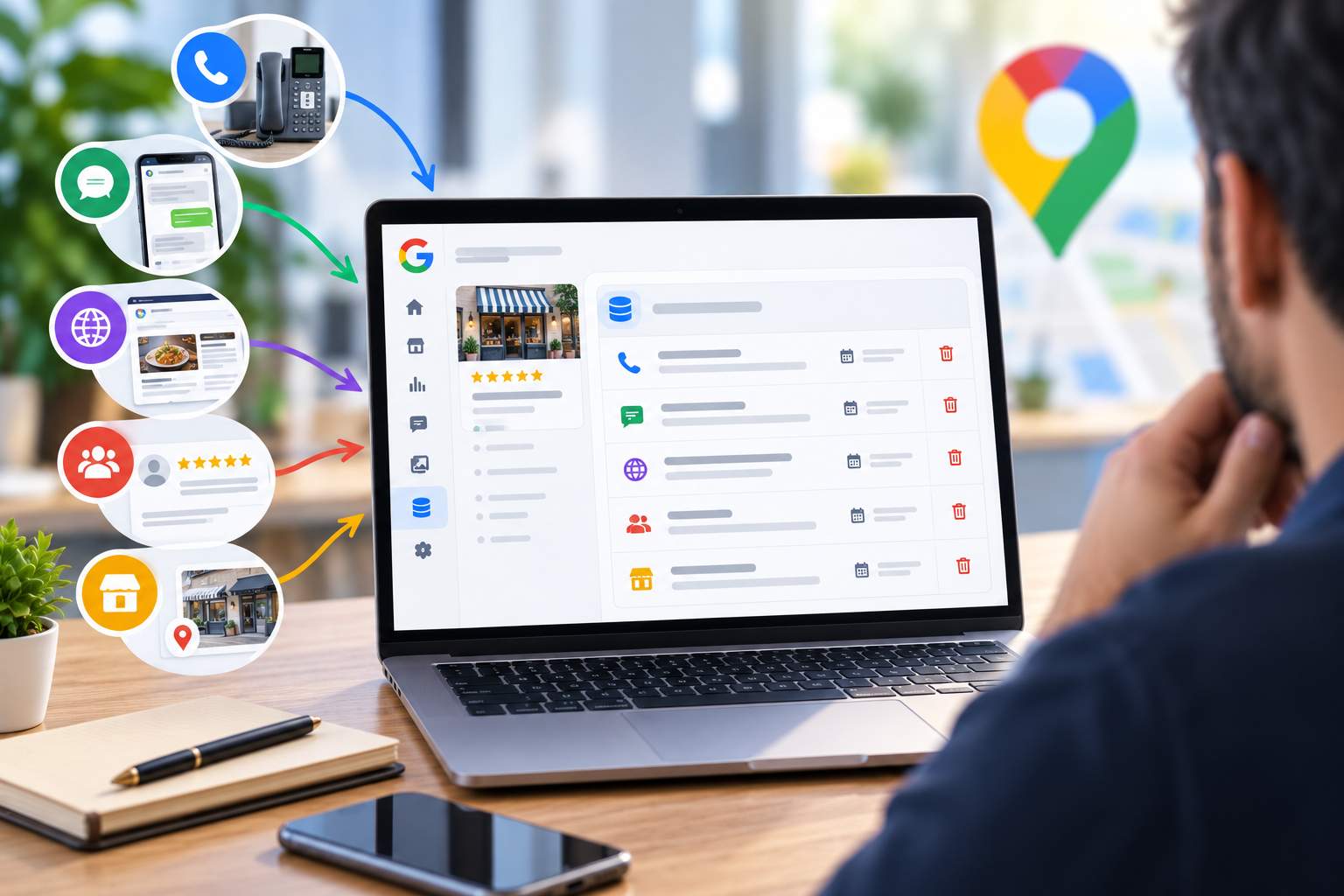
The displayed layer draws from the business profile, never from the website. Name, category, hours, photos, Q&As, reviews, and responses to reviews: everything that appears in AR comes from there. A heating contractor in Villeurbanne who has neglected his listing since 2021 will see incorrect business hours and a flash-lit photo of a van displayed. His mobile competitor will be the neighbor’s app, which is up-to-date and features photos.
Field observations confirm this hierarchy. Among the support initiatives carried out for independent businesses, listings with more than forty recent photos and a response rate to reviews exceeding 80% consistently generate more calls and route requests. AR amplifies this disparity rather than correcting it.
What the digital layer displays depends on the quality of the profile
| Level of the fact sheet | Augmented Reality Rendering | Effect on the wearer |
|---|---|---|
| Listing does not exist | No overlay; facade not recognized | The business does not exist digitally |
| Basic listing (name, address) | Gray dot, no rating | Uncertain, unfavorable comparison |
| Complete listing, rating 3.2 | Stars visible, negative reviews on the surface | Avoided in favor of the neighbor |
| Optimized listing, rating 4.6, active responses | Photos, signature dishes, responsiveness badge | In-store visits, higher average basket size |
Analyses published on the impact of Google reviews on local revenue show that a difference of just 0.5 stars is enough to influence purchasing behavior—even before any immersive experience is introduced. When superimposed on the storefront window, this difference becomes a neon sign.
A note for multi-location chains: consistency across locations is critical. A Toulouse franchisee with a 3.4-star rating drags down the perceived image of the entire brand when a passerby compares two locations on the same pedestrian street. Centralized management of local reputation is no longer just an administrative convenience.
Immersive user experience: businesses that turn AR into a machine for generating positive reviews
Augmented reality doesn’t just display reviews; it also creates new reasons to leave them. A customer who has a memorable digital experience in-store is happy to share their enthusiasm. The technology becomes a source of reviews, provided it serves a real need rather than being just a gimmick.
The best-documented example comes from the furniture industry. IKEA Kreativ lets customers visualize a sofa in their living room before purchasing it, bridging the gap between expectation and delivery. The result: fewer disappointments, fewer returns, and more satisfied customer reviews. The same logic applies at the local optician, which offers virtual try-ons for eyeglass frames, or at the tile installer who projects three tile designs onto the customer’s bathroom wall.
Three profitable applications for an independent business
- The visualization feature covers: furniture, flooring, and appliances. Customers can view, approve, and order without hesitation.
- Virtual try-on: eyewear, makeup, jewelry. WebAR works directly in a browser, with no app installation required.
- Augmented storefront: A QR code on the storefront triggers a showroom tour, even when the shutters are down. Sundays become a day for prospecting.
Marc, a cabinetmaker in the Vaucluse region, is a perfect example of how this works. Since he doesn’t have enough space to display his fifteen table models, he has recently started offering a scale projection at the customer’s home. His sales pitch has changed: instead of describing, he shows. Customer reviews now spontaneously mention, “We were able to see the table in our kitchen before ordering.” This phrase is worth its weight in gold, because it reassures the next prospective customer who has exactly the same concern.
The Pitfall of Free Demonstrations
An immersive experience with no tangible benefit is forgotten in ten seconds. A fun feature that doesn’t help anyone make a decision brings a smile, not a sale. The rule can be summed up in one sentence:the user experience must resolve a purchasing uncertainty, reduce effort, or save time.
The findings detailed in this analysis of AR usage in retail point to the same trend: systems installed simply for the novelty factor are shut down after six months due to lack of use. Those that address an identified pain point continue to operate years later.
That leaves the conversion to a review. The best time to ask for a review is right after the positive emotion, not three weeks later via email. A contractor who shows the final result superimposed on the completed job site has found the ideal moment. Enthusiasm turns into a five-star rating while it’s still fresh.
Generative AI and local recommendations: the rating becomes an entry filter
Conversational assistants already select the businesses they recommend, and their primary criterion remains overall reputation. A search engine that responds to the query “Which plumber should I call in Rennes?” selects from among the highest-rated, most-reviewed, and most responsive profiles. Augmented reality will soon serve as the interface for displaying these recommendations, directly in the user’s field of view.
This convergence changes the equation. In the past, a poorly rated business remained accessible via a direct search: the customer would type in the name, find the address, and go there. In the future, the assistant will filter results upfront, and the AR layer will visually confirm the verdict on the street. Two successive barriers, powered by the same data.
The signals that the models prioritize
- The volume of recent reviews: A 4.8 rating based on twelve reviews from 2022 carries less weight than a 4.4 rating that is updated weekly.
- The consistency of the manager’s responses, an automatically measurable indicator of reliability.
- The semantic richness of comments: Reviews that describe a specific service provide better input for the models than anonymous “great, thanks” comments.
- Consistency of information across the business listing, website, and professional directories.
One healthcare professional perfectly illustrates the issue at hand. When it comes to speech-language pathologists’ online reputation, a practice mentioned by a voice assistant captures the request of a stressed-out parent looking for a quick appointment. The neighboring practice, equally competent but with no online presence, never enters the conversation. Professional competence isn’t something you argue for in front of an algorithm—it’s something you demonstrate.
The flip side: the risk of negative experiences being exposed
Generative models can also convey criticism. When asked about a facility’s shortcomings, an assistant honestly summarizes recurring negative issues: wait times, cleanliness, and billing. Displayed in AR above a door, this summary serves as a counter-display. Inaction now comes at a public cost.
In this context, response time to reviews becomes a strategic indicator. Responding to legitimate criticism within 48 hours—with a concrete solution—defuses the negative sentiment before it becomes embedded in automated summaries. Leaving it unaddressed for three months is tantamount to tacitly acknowledging the complaint.
The trend described in this analysis of how AR is transforming retail boils down to one thing: continuity. The line between online searching and in-store browsing is disappearing. Local market shares are being redistributed in favor of those who refined their business model before the wave hit.
Preparing Your Digital Storefront: An Action Plan for Local Businesses Before the Immersive Wave
It’s cheaper to plan ahead than to play catch-up. A business owner who structures their business profile today, collects reviews systematically, and responds consistently will have a strong AR rating when the platform is rolled out on a large scale. The useful tools can be counted on one hand and require no monthly subscription.
First task: ensuring the listing is complete. Correct primary category, relevant secondary categories, actual hours of operation including any special closures, filled-in attributes (access for people with disabilities, outdoor seating, contactless payment), and a well-written description. Every empty field appears as a blank space in the immersive view.
Second project: the photo library. Visual recognition relies on images of building facades to identify locations. A storefront photographed from multiple angles during the day directly improves detection. A business without an exterior photo runs the risk of not being recognized by a passerby’s camera.
Third area of focus: regularly collectingcustomer reviews. A steady pace is better than a massive campaign followed by six months of silence. Ten reviews a month for a neighborhood bakery are enough to maintain a credible sense of freshness.
Twelve-week implementation plan
- Weeks 1–2: Comprehensive profile audit, correction of outdated information, standardization of the business name across all directories.
- Weeks 3–4: Photo shoot (exterior, interior, team, flagship products), staggered publication.
- Weeks 5–8: Implementation of the review collection system (QR code at checkout, post-service text messages, thank-you card).
- Weeks 9–10: Follow up on pending responses, starting with the most visible reviews.
- Weeks 11–12: Create local content and city-specific service pages on the website to ensure consistency across sources.
Let’s take another look at Camille, the Bordeaux brewer. Three months after implementing this protocol, her rating rose from 4.1 to 4.5, her reviews mention that Saturday night service has improved, and her listing now features eighty photos. The same group of tourists who used to whip out their phones in front of her patio now see a positive signal. The technology hasn’t changed—but the underlying data has.
One final budgetary consideration for independent creators interested in a proprietary immersive experience: WebAR, which is accessible via a browser, eliminates app development costs. The detailed analyses in this strategic breakdown of immersive experiences show that a lightweight, well-targeted solution outperforms a heavy-handed project that’s poorly integrated into the customer journey.
Key Takeaways
- Local reputation moves from the search screen to storefronts: the sidewalk becomes a results page.
- No immersive layer is superimposed on an incomplete profile. The business listing determines the digital presence of the local business.
- Generative assistants filter information upstream; augmented reality confirms it downstream. Two barriers fueled by the same reputation signals.
- Transparent reviews benefit responsive business owners: quick responses, up-to-date photos, and regular data collection.
- The work is done in-house, without a subscription: twelve weeks of methodology are better than a costly tool that’s poorly utilized.