Half an hour a month. That’s all it takes to stay on top of your online reputation—where 95% of consumers form an opinion of you before they even walk through your door. A well-honed monthly checklist turns a vague chore into a precise routine: twelve steps, thirty minutes, and you’ll know exactly where you stand on Google, with customer reviews, and in terms of your local visibility. Better yet: you’ll spot attacks and fake reviews before they drag down your Google rating. Here’s the complete, field-tested method for managing your reputation without spending your evenings on it.
In short:
- Just 30 minutes a month is all it takes to review the key aspects of your business’s online reputation and anticipate potential issues.
- An extra star on Google can boost your revenue by 5 to 9%: the rating isn’t just for show—it drives sales.
- Generative AI primarily recommends companies with high brand recognition and good ratings. Without monitoring, your competitors will scoop up all the mentions.
- Monitoring your Google reviews, social media mentions, and the consistency of your information helps prevent a crisis from snowballing.
- A fake review spotted early on is easier to challenge than one that has gone viral.
Why a Monthly Online Reputation Checklist Makes All the Difference
A monthly checklist is your dashboard. By performing twelve checks every month, you can make monitoring your online reputation second nature, rather than finding out about it only when a customer alerts you to a scathing review. The goal is simple: to stay one step ahead instead of reacting after the fact.
Take Camille, for example, who runs a pastry shop in Bordeaux. For two years, she only checked her Google listing when a review made her jump. The result: a string of three negative reviews posted in one week by a jealous competitor—which she spotted too late—caused her rating to drop from 4.7 to 4.3. Those three-tenths of a point, in her neighborhood saturated with tea shops, caused her to slip in the Google Maps rankings.
The cost of a neglected online reputation is measured in lost customers. When 60% of consumers decide not to make a purchase after reading negative reviews, every unaddressed negative review opens the door to the competition. The checklist acts as a regular filter that catches early warning signs before they turn into full-blown crises.
The Pace That Really Works for a Retailer
Not everything needs to be monitored at the same frequency. Google reviews and social media are worth checking daily, while in-depth audits should be conducted monthly. This tiered approach helps prevent burnout: no one can maintain comprehensive daily monitoring over the long term.
Here’s the rhythm to keep in mind so you don’t miss a thing:
| Item to monitor | Ideal Frequency | Estimated time |
|---|---|---|
| New Google Reviews and Responses | Daily | 5 minutes a day |
| Social Media Credits | Daily | 3 minutes a day |
| Google Search Results | Weekly | 10 min |
| Comprehensive Audit (the checklist) | Monthly | 30 min |
| Local Competitive Analysis | Monthly | included in the audit |
The benefit of a set monthly meeting is that it keeps you on track. Set aside the first Monday of the month at 9 a.m., coffee in hand, and go over your twelve points. After three months, you’ll know your numbers by heart and be able to spot an anomaly in a matter of seconds.
This consistency also pays off with Google: an active, well-maintained business listing sends a signal of reliability that the algorithm values in the Local Pack. Camille’s lesson can be summed up in one sentence: you can only truly protect what you check on often.
12 Things to Check on Your Google Business Profile
At the heart of the checklist are these twelve targeted checks of your Google Business Profile, your reviews, and your visibility. Each one takes two to three minutes. Together, they provide a comprehensive assessment of your digital health in just half an hour, stopwatch time.
Let’s start with the foundation: the listing itself. The first six points cover what Google displays directly to users who are searching for you.
- Average rating and number of reviews: track these every month. A sudden drop may indicate an attack or an internal issue.
- Consistency of NAP (name, address, phone number): Make sure they are the same everywhere. Inconsistencies can negatively impact your local search rankings.
- Up-to-date hours: holidays, days off, and special closures. Nothing is more annoying than a closed door that’s advertised as open.
- Recent photos: Add at least one per month. Listings with recent photos get more clicks.
- Categories and attributes: Please confirm that your primary and secondary business activities match the services you actually provide.
- Active Google Posts: One or two per week keep the listing active in the eyes of the algorithm.
The following six points broaden your focus beyond Google, because your reputation is also at stake elsewhere.
- Unanswered reviews: Track down those that have been left unanswered. Aim to respond within 24 hours, whether the review is positive or negative.
- Suspicious or fake reviews: Look out for comments that lack details, are posted in rapid succession, or come from fake profiles. These are easy to spot.
- Social media mentions: a quick look at Facebook, Instagram, and local groups to see what people are saying off the cuff.
- Google’s first page: Type in your name and check out the top ten results. Anything new? Anything negative?
- Other review platforms: Yellow Pages, Trustpilot, and TripAdvisor, depending on your industry. Your rating is also tracked there.
- Competitive Position: Compare your score to that of your three closest competitors geographically.
How to Spot a Fake Google Review Before It Causes Harm
A fake review often contradicts itself. A lack of specific details, a generic tone, and sometimes a mistake that appears in multiple comments posted on the same day—these are the hallmarks of a coordinated attack. The sooner you spot it, the more likely it is that reporting it to Google will be successful.
Thomas, a plumber in the Rhône region, saw five one-star reviews posted within 48 hours, all written by accounts created the day before. Thanks to his weekly monitoring routine, he documented each profile, recorded the dates, and filed a bulk report. Three reviews were removed within ten days. Without this quick response, they would have remained.
The golden rule: Always gather evidence (date, content, profile) before reporting. The structured monitoring methods detailed in this guide help you build a strong case. A single false report can be disputed; an undocumented wave of reports gets lost in the maze of Google’s support system.
Responding to Negative Reviews Without Making the Situation Worse
A response to a negative review should be calm, factual, and public. You’re not just responding to the dissatisfied customer—you’re speaking to the hundreds of prospective customers who will read the exchange later. The tone is everything: empathy, acknowledging the concern, and offering an offline solution.
Avoid reacting in the heat of the moment—that trap that turns a lukewarm review into negative buzz. The Streisand effect is lurking: the more aggressively you defend yourself, the more the issue blows up. A simple statement like “We’re sorry about this experience; please contact us to discuss it” defuses the situation better than a lengthy defense.
A hair salon in Lille saw its rating rise from 4.1 to 4.5 in six months simply by responding to every review within 24 hours, in a courteous manner. Prospective customers saw this as a sign of a business that cares, not one that tries to sweep its mistakes under the rug. Responding shows that you’re listening.
How Generative AI Is Transforming Your Local Reputation in 2026
AI assistants now recommend businesses by drawing from the highest-rated and most-cited sources. Specifically, when a customer asks an AI, “What’s the best auto repair shop near me?” the AI prioritizes businesses with high visibility and good Google ratings. Your AI reputation depends directly on your traditional online reputation.
This shift is a game-changer for local businesses. Yesterday, we were optimizing for Local Pack and Google Maps. Today, we also need to focus on the signals that generative models process: a consistent volume of reviews, a stable rating, and positive mentions spread across multiple platforms. A well-maintained listing becomes a source of trust for the algorithm.
The symmetrical danger warrants attention. These same AIs can amplify a negative customer experience if it lingers on the web without a response. A defamatory review ignored for months feeds the generative algorithm just as much as a glowing review. Monthly monitoring serves as a shield against this unforgiving digital memory.
Why Your Competitors Will Gain the Upper Hand If You Wait
The gap is widening rapidly. While you hesitate, the competitor who collects four reviews a month and responds to every one is building up a wealth of positive signals that propel them into the AI recommendations. This advantage accumulates, month after month, and becomes difficult to overcome.
Imagine two neighboring florists. One follows his monthly checklist, keeps his profile up to date, and reaches out to satisfied customers. The other lets things slide. After a year, the first has 120 reviews averaging 4.8, while the second has 30 reviews averaging 4.2. Guess which one the AI suggests first when a passerby is looking for a birthday bouquet?
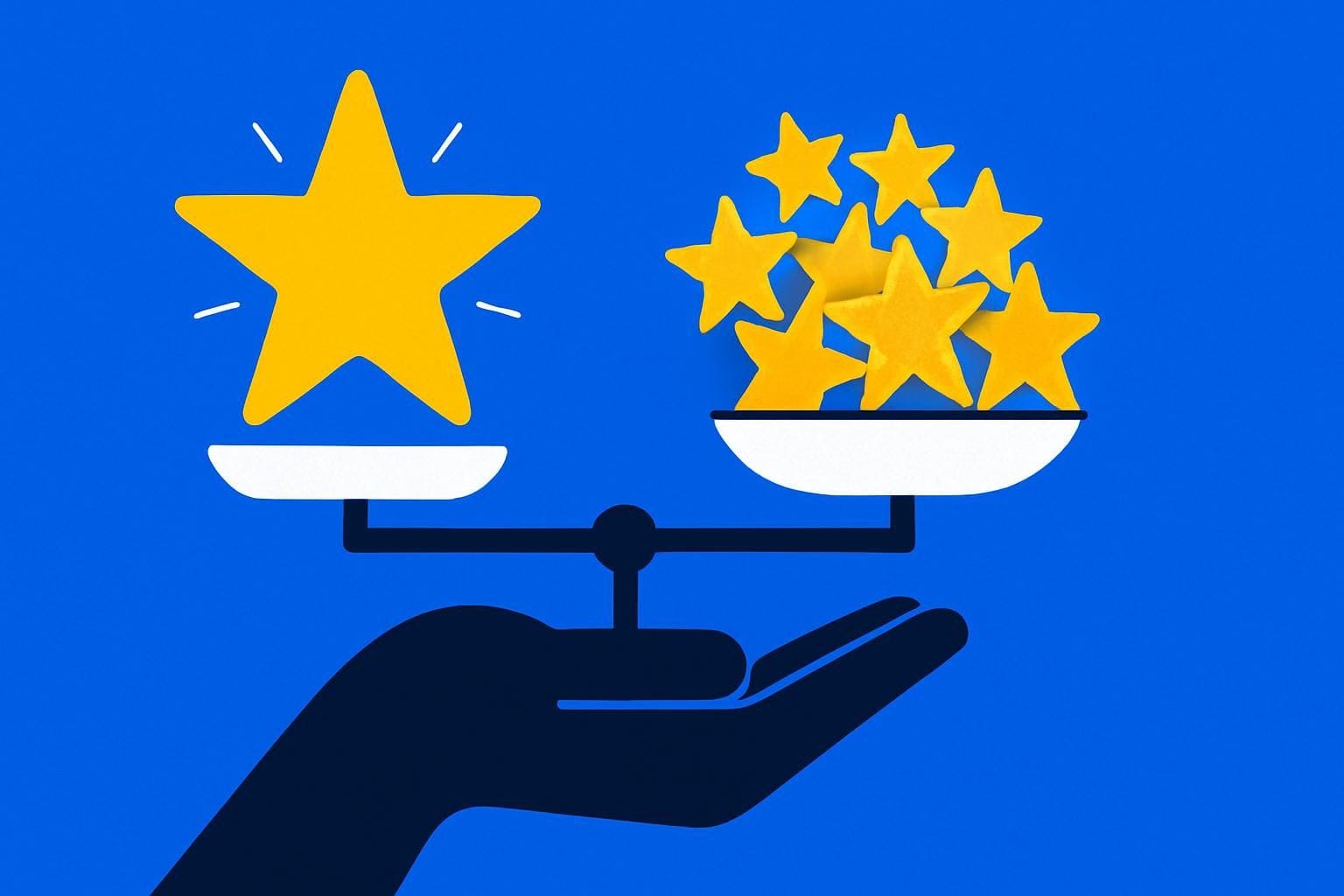
The numbers confirm the stakes: on average, it takes forty positive reviews to offset the damage caused by a single viral negative review. This imbalance rewards consistency and punishes inaction. The monitoring tools identified by Bpifrance help businesses keep up the pace without burning out. Waiting means giving up market share.
Build a body of reviews that resonates with algorithms
A steady stream is better than a spike. Four genuine reviews per month over the course of a year carry more weight than a flurry of forty reviews in a single week, which algorithms flag as suspicious. Consistency reassures both machines and humans.
Set up a simple way to solicit reviews: a QR code on the receipt, a polite text message after the service, or a direct request at the register. Marie, who runs a beauty salon in Nantes, slips a card with a QR code into each bag. The result: twelve reviews per month with no effort, a rising rating, and enhanced visibility on IA.
Also, use a variety of platforms. Prioritize Google above all else, followed by your website with visible customer reviews, then Trustpilot or the platform specific to your industry. This diversity creates a coherent body of evidence that AI systems cross-reference to assess your reliability. Building this capital is like building your best salesperson—one who works even while you sleep.
How to Detect and Manage an Online Reputation Crisis in 30 Minutes
You can spot a crisis through the early warning signs revealed by your monthly checklist: a sudden drop in ratings, a spike in negative reviews, or hostile comments on social media. If caught early, a crisis can be managed with a few targeted actions. If ignored, it will undermine your visibility for months.
The winning strategy consists of three steps: Assess the scope of the situation without panicking; prepare a calm, factual official response; and then actively rebuild the situation with positive content. Above all, don’t delete anything in a rush: clumsy deletions fuel suspicion and can sometimes fan the flames.
Sébastien, a restaurant owner in Toulouse, faced a viral video criticizing his service. Rather than hiding the comments, he posted a sincere response acknowledging the mishap, explained the steps he had taken, and then relaunched his campaign to gather positive reviews. Within two months, the positive feedback had overshadowed the incident. Transparency saved his business listing.
Warning signs your monthly audit should identify
Some indicators require an immediate response. A drop in ratings of several tenths within a few days, a surge in customer complaints, and a growing number of negative mentions on social media: these are all red flags that the monthly audit highlights before the situation spirals out of control.
Here are the alerts you should include in your monitoring routine:
- A sudden drop in the Google score: often the first sign of a targeted attack.
- A spike in complaints: a classic precursor to a wave of negative reviews.
- Drop in search traffic: a possible sign that negative content is outpacing you.
- Negative comments on social media: that’s where the bad buzz starts before it spreads to reviews.
- Loss of loyal customers: They may have come across something online.
Any signal detected early is easier to address. Step-by-step monitoring methods allow you to tailor these alerts to your business. A warned merchant is worth two overwhelmed merchants.
Rebuilding After the Storm Without Wasting Time
Recovery begins as soon as the incident is under control. Reach out to your most loyal customers—the ones who love you and have never thought to leave a review. Their genuine enthusiasm will quickly dilute the negative comments in a fresh, credible stream.
Be sure to publish original content as well: a Google Post about a new product, a blog post answering frequently asked questions, and recent photos. This content occupies digital space and pushes unwanted results deep into Google’s search results, where no one goes.
The key is regaining consistency. After a crisis, many business owners let their guard down once things have calmed down—only to be caught off guard again the next time an alert arises. Resuming the monthly checklist the very next day after the storm turns a bad experience into a reinforced routine. A solid online reputation isn’t afraid of storms—it learns to weather them.