Let’s imagine Sophie, the manager of a hair salon in Bordeaux. Her Google listing has a 4.8-star rating but only 7 reviews. Two blocks away, her competitor is stuck at 4.3 stars with 240 reviews. Guess who’s raking in the Saturday morning appointments? This battle between Google ratings and review volume is playing out in every neighborhood across France. And the results are surprising: a jump from 4.2 to 4.6 stars can boost your conversion rate, but even a 0.5-star improvement can generate 18% more traffic to a Google Business Profile listing. Here’s how to make the right choice for your business.
In short:
- At first glance, the Google rating is reassuring, but without sufficient volume, it loses all credibility in the eyes of both customers and AI systems.
- Reaching the threshold of 100 reviews with an average rating above 4.5/5 sends a strong signal of trust to Google and Gemini.
- 92% of French consumers read reviews before making a purchase (Ifop 2023).
- The first conversion jump occurs as early as 10 reviews, with an increase of up to 18%.
- In 2026, generative AI systems prioritize recommending entries with consistent ratings AND volume.
Google rating or number of reviews: Which one really influences conversion?
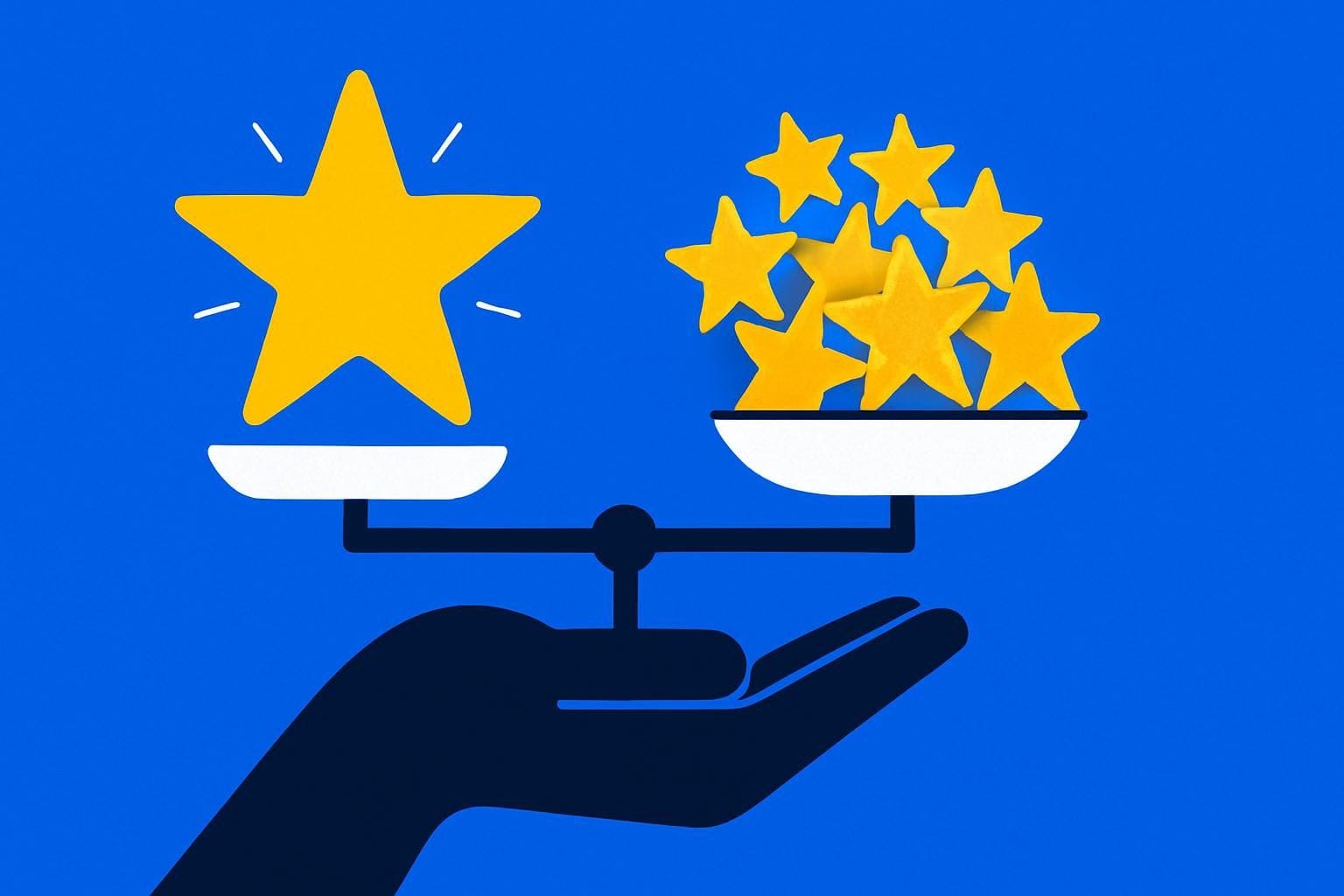
The honest answer can be summed up in one sentence: neither one alone is enough; it’s their combination that turns a curious visitor into a customer. A high rating with low volume inspires suspicion; high volume with a mediocre rating drives customers away. The real driver of conversion comes from striking a balance between the two.
Let’s go back to Sophie and her salon. Her 4.8-star rating shines, but 7 reviews tell a different story. A savvy customer might think that seven friends just left a nice comment—nothing more. The neighbor with a 4.3 rating based on 240 reviews tells a different story: a business that’s up and running, thriving, and owning up to its minor slip-ups. The collective voice builds trust where isolated perfection breeds doubt.
Studies agree that there is a nonlinear relationship between the number of reviews and commercial impact. With fewer than 5 reviews, the effect on conversion remains virtually zero. The first significant increase occurs around 10 reviews, at which point the conversion rate can jump by 18%. Beyond that, each subsequent increase boosts credibility, though not in a perfectly linear fashion.
Sterling Sky has shown that increasing the number of positive reviews from 3 to 16 significantly improves local search rankings. This is an achievable range for a tradesperson or restaurant owner just starting out. There’s no need to aim for a thousand reviews right off the bat—just reaching double digits already makes a big difference on Google Maps.
From a consumer psychology perspective, the rating acts as an instant filter. An online shopper mentally rules out anything with a rating below 4 stars in less than two seconds. But once past that filter, it’s the volume of reviews that seals the deal. The rating opens the door; the number of reviews brings the customer inside.
A baker in Lyon who was recently tracked illustrates this mechanism. His reviews went from 12 to 80 in six months while maintaining a 4.6-star rating, and he saw the number of phone calls he received through his listing triple. The rating hadn’t budged an inch; only the volume had increased. This proves that quantity makes a difference even when quality remains stable. To estimate your own thresholds, Localranker’s missing review calculator provides specific targets based on your current situation.
Key takeaway: Focus on volume as long as your rating is above 4.2, because that’s what drives growth. Once you’ve reached over 100 reviews, fight to maintain every tenth of a point in your average rating.
How Google Ratings Influence Initial Purchasing Decisions
The average rating acts like a bouncer at the entrance to a nightclub. Below a certain threshold, the customer walks right by without even giving it a second thought. Above that threshold, they’re willing to take a closer look at what you’re offering. This initial screening happens in a fraction of a second, almost without conscious thought.
Google sets an implicit threshold of around 4.2/5 to favor rankings in the Local Pack. Below that, the algorithm considers the quality signal insufficient compared to higher-rated competitors. Maintaining this minimum threshold is essential for survival in local SEO.
Let’s take the example of a mechanic in Toulouse stuck at 3.9 stars. Despite 150 reviews and impeccable work, his potential customers were hesitant. Three past negative experiences were dragging down his average rating. By addressing those reviews and relaunching his review campaign, he brought his rating back up to 4.4 in four months. His quote requests increased by 30%.
The classic trap is believing that a perfect score is better than anything else. A perfect 5.0/5 based on 15 reviews sounds fishy. Today’s customers can spot rigged reviews—or even fake Google reviews—a mile away. An average between 4.5 and 4.8 seems much more authentic than a suspiciously flawless score.
The lesson: Aim for credibility over perfection, because a slightly imperfect but widely shared post reaches more people than a perfect but hollow one.
How Many Google Reviews Do You Need to Boost Your Rating and Local SEO?
There’s no universal magic number, but there are clearly defined trust thresholds: 10, 50, and 100 reviews. The first unlocks conversions, the second establishes credibility, and the third sends a strong signal to Google and AI systems. It all depends on where you’re starting from.
The Google rating works as a volume-weighted average. The more reviews you have, the more new 5-star reviews it takes to make a difference. A business with 30 reviews can raise its average in a matter of weeks, whereas one with 500 reviews sees its average rise only very gradually.
Let’s do the math for Sophie. With 7 reviews averaging 4.8, a single 3-star review would drop her average to 4.5. That’s a dangerous level of volatility. In contrast, the mechanic with 150 reviews can take a negative review in stride. Volume protects as much as it converts.
| Notice Period | Impact on Conversion | Local SEO Signal |
|---|---|---|
| 0 to 5 reviews | Virtually no impact | Stars Appearing on the Card |
| 10 to 16 reviews | First jump (+18%) | Significant improvement in positioning |
| 50 reviews | Established credibility | Local competition left behind |
| 100+ reviews with a rating of 4.5/5 | Maximum conversion | Strong Trust Signal (Semrush) |
According to Semrush, having more than 100 reviews with an average rating of at least 4.5/5 is the threshold that really boosts your ranking on Google Maps. Once you have more than 16 reviews, the SEO benefit slows down but remains noticeable. Continuing to collect reviews keeps the virtuous cycle going.
Because a cycle is indeed taking shape. More positive reviews lead to greater visibility, which leads to more clicks, which leads to more customers, which leads to more reviews. It’s a cycle that spins all the faster the sooner you get it started. Resources like this analysis on the impact of the number of reviews on local visibility confirm that this volume accounts for up to 12% of your local search rankings.
The fatal mistake would be to manipulate this system. Fake reviews and review gating result in penalties that cause search rankings to plummet. Google is getting better and better at detecting artificial patterns. The patience required for honest review collection always pays off more than a fraudulent gamble.
Final tip: Set 100 reviews as your goal, but celebrate every milestone along the way that brings your business closer to its competitors.
Best Practices for Collecting Reviews Without Cheating
Creating a steady stream of feedback remains the golden rule. A single review every three months doesn’t accomplish anything. A consistent strategy turns every satisfied customer into a silent advocate. In the eyes of internet users, recency matters just as much as volume.
Asking in person works incredibly well in local shops. The baker in Lyon drops a word to each of his loyal regulars. This personal touch doubles the deposit rate compared to a simple, silent sign near the register.
The QR code on the counter catches the attention of customers in a hurry. An SMS or email campaign sent after the purchase reminds those who have forgotten. Using multiple channels increases response rates, as long as the approach remains natural and never pushy.
Signing up on other review platforms also enhances your business profile. Trustpilot and Facebook create valuable local backlinks for SEO. Diversifying your sources makes your online reputation stronger and harder to undermine.
Golden rule: never post fake reviews, never engage in review gating. The risk of a Google penalty outweighs any potential gains. The credibility of an honest listing is worth a thousand purchased stars.
Why Google Reviews Will Power AI in 2026
In 2026, generative AIs like Gemini will draw directly on your reviews to formulate their recommendations. A listing with few reviews will become invisible when a customer asks an AI for the best restaurant in the neighborhood. Your digital reputation now determines your visibility in automated responses.
Google’s AI Overviews scan all content that mentions your business: your website, Google Business Profile listing, Google reviews, and third-party platforms. Artificial intelligence synthesizes all of this information to generate a relevant response. Your reviews literally feed the algorithm that either recommends you or excludes you.
Let’s imagine a tourist in Marseille typing “good pizzeria near the Old Port” into an AI assistant. The model compares listings, cross-references ratings and review counts, and reads the content of the reviews. It will recommend the restaurant that combines high popularity with positively described experiences. Sophie, with only 7 reviews, simply won’t factor into the equation.
This mechanism is a game-changer for businesses that have neglected their online reputation. AI doesn’t tolerate vagueness; it prioritizes rich, recent, and authentic sources. Reports of negative experiences are also cited, sometimes without any filtering. A poorly rated business risks having its shortcomings summarized aloud by a voice assistant.
Brands that have understood this are already investing. Franchise networks are organizing data collection on a store-by-store basis. Each retail location becomes a data point for AI. Meanwhile, laggards are letting their competitors capture automated recommendations and the market share that comes with them.
The quality and authenticity of reviews take on a strategic dimension here. A detailed review that mentions a specific dish or names a particular staff member helps the AI understand your offering. Generic comments carry less weight. Encouraging detailed feedback becomes a real behind-the-scenes effort, as this guide on the link between reviews and conversions points out.
Final insight: Managing your online reputation in 2026 means speaking the language of AI. Those who remain silent disappear from recommendations; those who collect data intelligently dominate the field.
Responding to Negative Reviews to Turn Criticism into an Asset
Responding to a negative review is much more than just a defense—it’s a public demonstration of professionalism. 79% of consumers say they’ve changed their minds after reading a review, and 51% of them have reversed a decision in response to poorly handled negative comments (Ifop). A thoughtful response can turn the tide.
A defensive reaction undermines credibility. Let’s take the example of the mechanic in Toulouse again. When faced with a customer who was unhappy about a delay, he responded calmly, acknowledged the delay, and offered a goodwill gesture. This public response reassured ten prospective customers for every one who was critical. Transparency is more effective than silence.
Responding quickly and with a human touch makes all the difference. Automated response templates or AI-powered tools help you keep up with the volume without cutting corners. The key is to personalize every important response. An obvious copy-and-paste response does more harm than no response at all.
Positive reviews also deserve a mention. Thanking a loyal customer strengthens the bond and encourages others to share their experiences. This public dialogue builds an image of a business that is attentive, responsive, and vibrant—exactly what customers and AI are looking for. To learn more about how ratings work, this resource details how many reviews you need based on your profile.
Final insight: Every negative review handled well becomes free advertising for your professionalism—as long as you respond like a human, not like an annoyed robot.
Developing a review strategy that maximizes both rating and volume
A winning strategy refuses to choose between ratings and volume: it cultivates both simultaneously. Continuously collect reviews to boost the number, and address every piece of feedback to maintain the average rating. It is this dual approach that drives sustainable growth in a business’s conversion rate.
It all starts with getting that first review. This step triggers the display of stars on your Google listing and in rich snippets. Without it, your business remains visually invisible on the search results page. Customers see nothing to compare, so they move on.
Centralizing management on a single interface saves a tremendous amount of time. Having Google, Facebook, and Trustpilot all in one place eliminates the need to juggle ten tabs. A management tool lets you respond quickly, analyze trends, and identify recurring areas for improvement in the comments.
Here are the pillars of a solid review strategy for 2026:
- Always follow up after every successful transaction, either in person or via message.
- Make it easier to submit entries using a QR code, a direct link, and a very short form.
- Respond to 100% of reviews—both positive and negative—within 48 hours.
- Diversify platforms to increase the number of local signals and backlinks.
- Analyze trends on a monthly basis to address recurring issues.
- Display reviews on your website using a widget to boost direct conversions.
The review widget on your website deserves special attention. Displaying your Google, Facebook, and Trustpilot reviews directly on your pages reassures visitors without requiring them to leave the site. With modern solutions, no coding skills are required—just a simple copy-and-paste that you can customize to match your brand.
Autonomy remains the key. Rather than relying on a service provider with a costly subscription, a merchant can manage their own reputation. Understand the mechanisms, automate what can be automated, and maintain a human touch. This approach protects the budget while strengthening in-house expertise. Analyses such as these 2026 conversion statistics or this data-driven overview of Google reviews help drive data-driven decision-making.
Then there’s the legal aspect, which is all too often overlooked. A false, defamatory review or an attempt at extortion must be addressed systematically: report it, document it, and respond publicly with composure. Knowing your rights protects your online reputation just as much as a well-managed online presence builds it.
Final insight: The rating is reassuring, the volume is impressive, but it’s the consistency of a well-executed strategy that wins the local race. Sophie and her salon realized this too late; your competitors, perhaps not yet.