
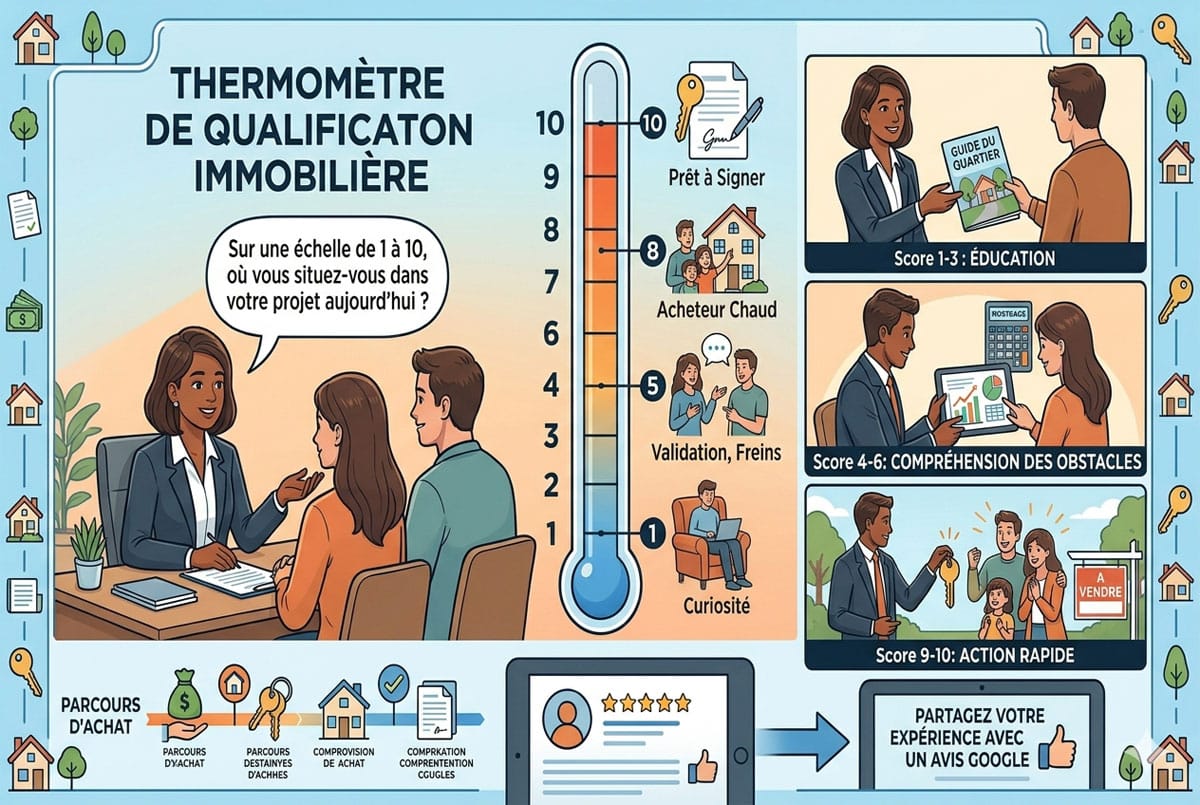
We're continuing our series of effective AND notice-generating sales techniques! Episode 2: In the real estate business, time is the most precious resource. Every hour spent with a "real estate tourist" is an hour lost for a serious buyer. The thermometer technique enables you to quickly identify where each prospect is in his or her buying journey.
Summary and contents of the page
Basic principle of the thermometer
The thermometer is a scale from 1 to 10 that measures the maturity of an acquisition project. 1 means "mere curiosity with no concrete project", 10 means "ready to sign tomorrow if the property matches". This objective measure replaces subjective impressions, which are often misleading.
How to ask the question effectively
Wording is everything. Avoid the blunt "Are you really a buyer? Instead, say: "I'd like to understand what stage you're at. If 1 means you're starting your search and 10 means you're ready to make an offer as soon as you find the right property, where do you stand today?"
This open-ended question invites reflection without pressure. It positions the agent as an advisor rather than a salesperson.
Interpret responses and adapt your approach
Answer between 1 and 3 – Discovery phase
Prospects compare neighborhoods, refine their criteria and evaluate their borrowing capacity. Offer them educational resources rather than visits: neighborhood guides, loan simulators, articles on the buying process. Schedule an update in 4 to 6 weeks.
Response between 4 and 6 – Real project, remaining obstacles
Ask the follow-up question: "What would it take to get to 8 or 9?" The answers reveal the real obstacles: validation of financing, spouse's agreement, prior sale of a property, job search in progress.
Answer between 7 and 8 – Hot buyer
Identify the missing element(s) with precision: "You're at 7, what's stopping you from being at 10?" Often, these are details you can resolve immediately.
Answer 9 or 10 – Absolute priority
This prospect needs to see your best properties within 48 hours. If they wait, they risk signing with a competitor.
Practical application after a visit
The thermometer is particularly useful after a visit. "Now that you've seen the property, where do you stand on the scale?" If the prospect goes from 6 before the visit to 4 afterwards, the property is not a good match. There's no need to insist: instead, try to understand what they didn't like, so you can refine your future selection.
If the score increases, follow up with the commitment question: "You've gone from 5 to 7, which is encouraging. What would you like now: a second visit with your wife, or a financing simulation on this specific property?"
Use the thermometer to prioritize your portfolio
Keep a tracking table of your prospects with their thermometer score updated after each interaction. Concentrate 80% of your time on prospects with 7 or more. The others deserve regular but less intensive follow-up.
This rational prioritization mechanically multiplies your conversion rate. Agents who apply it rigorously convert on average 40% more than those who treat all prospects equally.
From thermometer to sale: the virtuous circle
A well-qualified prospect becomes a well-supported customer. They don't waste time on unsuitable visits, their financing is validated upstream, and their criteria are clarified. The transaction is concluded more quickly, with less friction.
This professionalism generates superior customer satisfaction. Word-of-mouth works, referrals flow in, and your reputation is built on a solid foundation.
When and how to ask for Google’s opinion using the thermometer method
The thermometer gives you a precise indicator of the optimum time to seek advice. Wait until your customer has reached the final "10": signing at the notary's office and handing over the keys.
The request for advice is a natural extension of your last exchange: "Do you remember our first appointment? You were at 5 on the thermometer. Today, you're a homeowner. This journey together has been a pleasure. If you've enjoyed my guidance, a Google review would help others in your situation to trust me. Here's the link: [direct link to your Google Business Profile]."
This formulation reminds us of the road we've travelled together and enhances the value of the relationship we've built up. It makes the advice natural rather than transactional.
For qualified prospects who don't end up buying with you (property sold before their offer, change of project), ask for feedback on the quality of your support. These testimonials to your professionalism, even without a transaction, reinforce your credibility.

